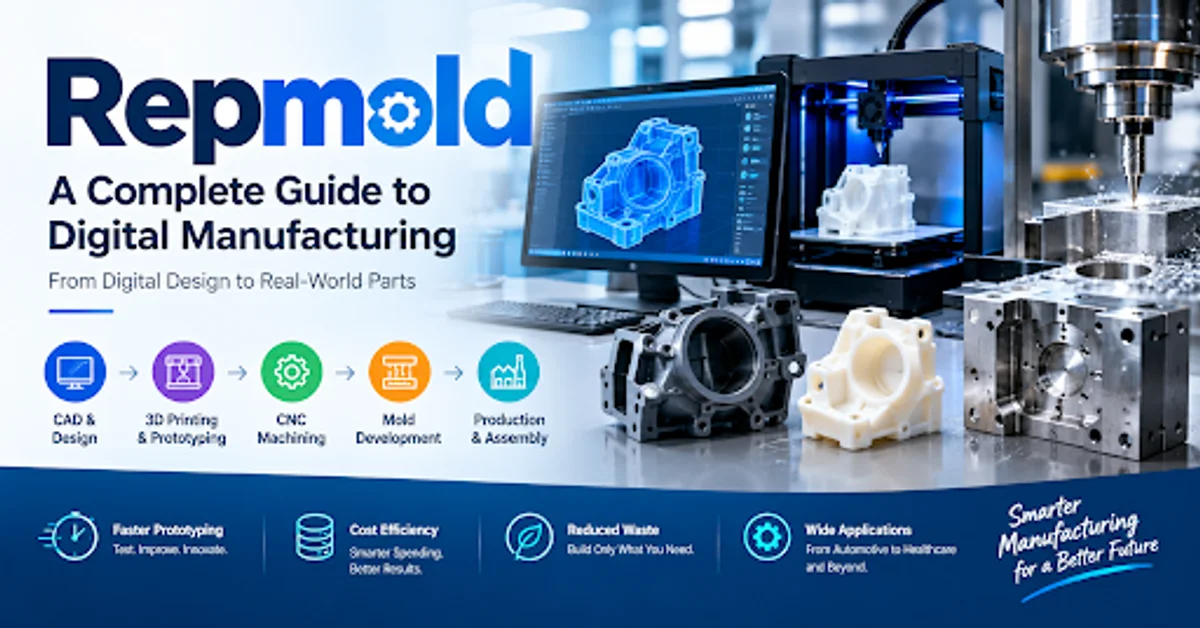
Repmold is an emerging term associated with digital molding, mold replication, rapid prototyping, and modern manufacturing workflows. It is commonly used to describe approaches that combine digital design tools with established manufacturing methods to develop, test, and produce physical components. Although the term appears in online discussions about manufacturing innovation, it does not currently have one widely accepted technical definition.
The central idea behind Repmold is to make product development more flexible by connecting digital models with physical production. Engineers may use computer software to design a component, create a prototype, test its performance, and refine the design before investing in production tooling. These methods can help businesses develop products more efficiently while maintaining appropriate quality standards.
The technologies associated with Repmold are real and widely used across modern industries. Computer-Aided Design (CAD), additive manufacturing, CNC machining, injection molding, and industrial automation are established manufacturing methods. However, Repmold itself is not currently recognized as a standardized manufacturing process with a universally accepted specification or confirmed official developer.
This distinction matters when evaluating online claims. Repmold is best understood as a loosely defined term for manufacturing approaches that combine digital design, prototyping, mold development, and production. Its potential benefits should be assessed through the actual technologies involved rather than assumptions about the name.
Related: Merfez: Lifestyle, Design, and Digital Organization
How Does Repmold Work?
Step-by-Step Repmold Manufacturing Process
A typical Repmold-style workflow begins with a digital design or a scan of an existing object. Engineers use CAD software to create or modify the product model, checking dimensions, geometry, wall thickness, and other important characteristics. Simulation tools may help identify potential weaknesses before a physical prototype is produced.
The next stage involves prototype development, testing, and design refinement. Depending on the project, manufacturers may use 3D printing, CNC machining, casting, or temporary tooling to produce a sample. After the prototype meets the requirements, the team can develop production tooling and establish a suitable manufacturing process.
From Digital Design to Physical Production
Once the design is approved, the digital model can guide the production of molds, inserts, fixtures, or finished components. Computer-Aided Manufacturing (CAM) software can translate manufacturing instructions into machine operations, helping connect design work with physical production. The selected process depends on the material, required precision, product geometry, and production quantity.
Quality control remains essential throughout the workflow. Manufacturers may measure dimensions, inspect surfaces, test mechanical performance, and compare finished parts with approved specifications. A digital design can improve consistency, but it cannot guarantee that every manufactured component will be accurate without suitable equipment, process controls, and inspection.
Technologies Used in Repmold
CAD, 3D Printing, and 3D Scanning
Computer-Aided Design is a foundation of digital manufacturing because it allows engineers to create, inspect, and modify detailed product models. CAD files can be shared with manufacturing teams and used to prepare prototypes, molds, and production instructions. Changes can often be tested digitally before expensive tooling is manufactured.
Three-dimensional scanning provides another route to digital design by capturing the shape of an existing object. The resulting data may help with reverse engineering, repair, or replacement-part development, although the scan often requires correction in CAD software. Additive manufacturing, commonly called 3D printing, can then turn a digital model into a physical prototype by building it layer by layer.
CNC Machining, Automation, and AI
Computer Numerical Control (CNC) machining uses programmed instructions to control cutting tools and manufacture components from solid materials. It is useful for producing accurate prototypes, mold inserts, and tooling components. CNC machining may complement 3D printing when a project requires specific tolerances, durable materials, or carefully finished surfaces.
Industrial Automation and Robotics can help manufacturers repeat tasks, move materials, assemble components, and inspect products. Internet of Things (IoT) sensors may collect information about temperature, vibration, pressure, and machine performance. Artificial Intelligence (AI) can support design optimization, production analysis, and predictive maintenance, but these technologies are optional additions rather than mandatory features of every Repmold-style workflow.
Key Benefits of Repmold
Faster Prototyping and Design Flexibility
One of the main Repmold benefits is the potential to make product development more flexible. Digital models allow engineers to modify dimensions, compare design alternatives, and correct problems before committing to permanent tooling. Rapid Prototyping also gives teams an opportunity to examine the physical product rather than relying exclusively on computer simulations.
This flexibility can support startups, established manufacturers, engineering teams, and research laboratories. For example, a company developing a plastic enclosure could test several designs before selecting the final version for injection molding. Early testing may reveal assembly problems, uncomfortable shapes, or unsuitable dimensions while changes are still relatively straightforward.
Cost Efficiency and Reduced Material Waste
Digital manufacturing may reduce development costs when it helps teams avoid unnecessary tooling changes and repeated production mistakes. Rapid tooling and temporary molds can also be useful for limited production runs or early product testing. However, savings depend on equipment availability, engineering time, material selection, and the complexity of the product.
Waste reduction is another possible advantage. Identifying design problems before manufacturing thousands of parts may prevent discarded products and unnecessary material consumption. Nevertheless, 3D printing, machining, and molding each have different resource requirements. Businesses should compare actual project costs and material use instead of assuming every Repmold process will be cheaper or more efficient.
Common Applications of Repmold
Automotive, Aerospace, and Electronics
The manufacturing techniques associated with Repmold can support automotive product development by helping engineers create prototypes of housings, brackets, interior components, and tooling. Digital models allow teams to review component fit and revise designs before moving into larger production runs. These advantages are especially useful when products require multiple design iterations.
Aerospace manufacturers may use additive manufacturing, simulation, and precision machining to develop complex components, although safety-critical parts require strict testing and documentation. Electronics companies can use similar methods to prototype device enclosures, connectors, wearable products, and internal housings. These examples demonstrate established digital manufacturing applications, not independently verified case studies of a proprietary Repmold technology.
Healthcare, Consumer Goods, and Industrial Manufacturing
Healthcare applications may include anatomical models, prosthetic development, device prototypes, and customized components. Three-dimensional scanning and CAD can help engineers design products around specific dimensions. Medical products intended for clinical use may require additional testing, regulatory compliance, and professional approval.
Consumer-goods manufacturers can apply digital manufacturing methods to handles, containers, household products, and customized accessories. Industrial companies may use them to develop replacement parts, specialized fixtures, and equipment components. The most suitable method depends on product requirements, material properties, production volume, and applicable safety standards.
Repmold vs. Traditional Molding
Key Differences in Process and Production
Traditional molding uses a mold or cavity to shape material into a required form. Injection molding, for example, injects molten material into a mold, where it cools and solidifies. It is a well-established method for producing large quantities of consistent plastic components.
A Repmold-style workflow places greater emphasis on digital design, rapid prototyping, and flexible mold development before or during production. These methods can complement traditional molding rather than replace it. Engineers might test a design with 3D printing, refine the mold digitally, and then use conventional injection molding for the final product.
Cost, Efficiency, and Scalability Comparison
Digital prototyping can be attractive during early development because it allows design changes before permanent tooling is completed. This may reduce the cost of correcting errors and help teams evaluate different versions of a product. However, digital equipment, software, and engineering services also have costs that must be considered.
Traditional molding often becomes more economical when production volumes are high. Although the initial mold may be expensive, it can produce many parts efficiently. The right choice depends on quantity, tooling life, material, cycle time, and quality requirements. A hybrid workflow often provides a practical balance between design flexibility and large-scale production efficiency.
Repmold vs. 3D Printing
Understanding Their Main Differences
Repmold and 3D printing are not interchangeable terms. Three-dimensional printing is a specific additive manufacturing process that creates objects by depositing material in successive layers. It is useful for prototypes, complex geometries, customized components, and certain low-volume production tasks.
Repmold, by contrast, is a loosely defined term that may describe a broader workflow involving CAD, scanning, prototyping, mold development, and conventional production. A manufacturer using this approach might print a prototype, improve its design, and then produce the final component through injection molding or CNC machining.
Choosing the Right Manufacturing Method
3D printing may be suitable when a business needs a small number of parts, frequent design changes, or complex shapes. It can avoid the need for dedicated production molds, although printing speed, material properties, surface finish, and post-processing requirements must be evaluated.
Traditional molding may be preferable for large quantities of identical components, particularly when the mold has already been manufactured and production is stable. CNC machining can be a better option for certain precision parts or materials. The best manufacturing method is the one that meets the project’s performance, budget, delivery, and quality requirements.
Repmold Costs and Limitations
Equipment Costs, Materials, and Pricing Factors
There is no confirmed universal Repmold cost or official pricing structure because the term does not identify one standardized commercial product. Project expenses depend on the actual tools and services used, including CAD software, 3D scanning, prototype production, CNC machining, mold construction, testing, and engineering labor.
Material selection also influences the total cost. Standard plastics may be economical for some applications, while specialized polymers, composites, and high-performance metals can be more expensive. Manufacturers should consider initial investment, tooling life, maintenance, production speed, and cost per part before choosing a process.
Technical Challenges and Quality Control
Repmold limitations include equipment costs, training requirements, material constraints, software compatibility, and difficulties scaling prototypes into mass production. A process that works well for ten samples may not provide the speed or consistency needed for thousands of components. Manufacturers must validate the process before increasing output.
Quality Control is particularly important when components must meet strict dimensional or performance requirements. Materials may behave differently during printing, machining, or molding, and surface defects or dimensional variation can affect product reliability. Manufacturing Engineering teams may use inspection equipment, testing procedures, and process monitoring to maintain consistent results.
Sustainability and the Future of Repmold
Digital Manufacturing and Sustainable Production
Repmold sustainability depends on how its associated manufacturing technologies are selected and operated. Digital prototyping may reduce waste by identifying design errors before large production runs begin. Some additive manufacturing processes can also reduce material removal compared with machining, although support structures, failed prints, and finishing work may create additional waste.
Materials Science and Polymer Science can help engineers select materials based on durability, recyclability, heat resistance, and intended use. Sustainable Manufacturing requires a broader assessment of energy consumption, transportation, material sourcing, product lifespan, and end-of-life disposal. Digital manufacturing is not automatically environmentally friendly, so its impact should be measured for each application.
AI, Smart Factories, and Emerging Trends
Repmold future technology discussions often include AI-assisted manufacturing, connected sensors, robotics, and digital simulation. In a Smart Factory, IoT sensors can monitor machine conditions and production data, while software helps operators identify process changes. AI tools may support defect detection, design optimization, and predictive maintenance when suitable data and validation are available.
Digital Twin technology creates a virtual representation of a physical product, machine, or production system. Engineers can use digital twins and Computer-Aided Engineering (CAE) tools to study operating conditions and potential design improvements. Finite Element Analysis (FEA) can estimate how a model may respond to loads, heat, or vibration, although simulation results depend on accurate assumptions and must be validated when necessary. These established technologies may shape future manufacturing workflows, but they do not prove that Repmold is a formally defined platform.
Is Repmold Worth Using?
Who Can Benefit from Repmold-Style Manufacturing?
Repmold-style manufacturing may be useful for product designers, engineers, startups, manufacturers, and research organizations that need flexible prototyping or digital mold development. It can help teams test concepts, compare designs, produce customized components, and identify problems before investing in large-scale tooling.
Businesses with frequent design changes or specialized low-volume requirements may particularly benefit from digital workflows. However, organizations should identify the specific technologies they need instead of purchasing equipment based solely on the Repmold name. Established manufacturing processes may remain more practical for straightforward, high-volume products.
Key Factors to Consider Before Choosing Repmold
Before adopting a Repmold-style process, evaluate the required production quantity, material, dimensional tolerances, surface finish, budget, delivery schedule, and available expertise. Consider whether the project needs a prototype, a temporary mold, a production mold, or a finished part made directly through additive manufacturing or machining.
Businesses should also examine supplier experience, safety requirements, quality documentation, intellectual-property protection, and equipment compatibility. Digital files must be managed securely, and scanning an existing product does not automatically grant permission to reproduce it. A clear assessment of these factors helps organizations select a manufacturing solution based on evidence and practical requirements.
Related: Rodwajlery: Complete Guide to the Rottweiler Dog Breed
Frequently Asked Questions
What does Repmold mean?
Repmold is an emerging online term associated with digital molding, mold replication, rapid prototyping, and modern manufacturing workflows. It does not currently have one widely accepted technical definition.
Is Repmold a real manufacturing technology?
The underlying technologies, including CAD, 3D printing, CNC machining, and injection molding, are established. Repmold itself is not widely recognized as a separate standardized manufacturing process.
What is Repmold used for?
Repmold-style workflows may support product design, prototype testing, mold development, customized manufacturing, replacement components, and preparation for larger production runs.
Is Repmold cheaper than traditional molding?
Not always. Digital prototyping may reduce early development expenses, while traditional molding can offer a lower cost per part for large production volumes. The result depends on tooling, materials, and production quantity.
Who invented Repmold?
No reliable evidence currently establishes a confirmed inventor, official developer, or universally recognized launch date for Repmold.
Summary
Repmold is an emerging term associated with digital molding, rapid prototyping, and modern manufacturing practices. Its underlying technologies—including CAD, 3D printing, CNC machining, automation, and injection molding—offer practical ways to improve product development, test designs, and produce components efficiently.
However, Repmold itself does not currently have a widely accepted technical definition, confirmed universal pricing structure, or established official developer. Its value depends on the specific manufacturing methods involved and the needs of each project. By evaluating costs, materials, quality requirements, scalability, and sustainability, businesses can make informed decisions and choose manufacturing solutions that deliver reliable results.