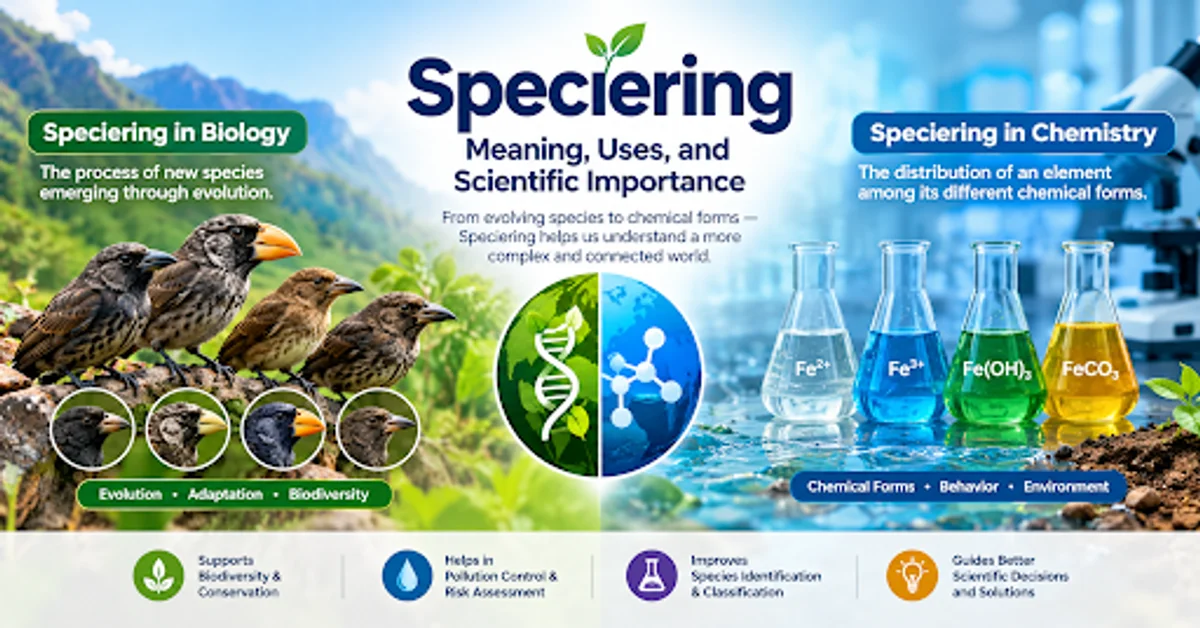
Speciering is a term that may refer to biological speciation or chemical speciation, depending on the context. In biology, it relates to the evolutionary process through which new species emerge. In chemistry, it refers to identifying and understanding the different chemical forms in which an element exists. Although these processes are distinct, both help scientists understand complex systems through meaningful differences.
The exact meaning of Speciering depends on the language and discipline in which it appears. In English scientific writing, speciation is the established term for the formation of new biological species, while chemical speciation describes the distribution of an element among its chemical forms. Understanding this distinction helps readers interpret scientific information accurately.
Speciering in science helps researchers move beyond broad labels and examine important differences. A biologist may investigate why two populations develop into separate species, while an environmental chemist may study why two forms of the same element behave differently in water or soil. In both cases, careful analysis improves scientific understanding.
This approach supports research in evolutionary biology, ecology, environmental chemistry, and analytical chemistry. It also helps scientists communicate findings clearly, make evidence-based decisions, and develop practical solutions to environmental challenges.
Related:Pellela: Exploring Its Heritage and Significance
Speciering in Biology
How New Species Form
Speciering in biology is closely associated with biological speciation, the process through which one population gives rise to distinct species. This process usually begins when populations experience different environmental conditions, genetic changes, or reproductive behaviors. Over many generations, these differences can accumulate until the populations become reproductively isolated.
evolutionary biology explains this process through mechanisms such as natural selection, genetic drift, and reduced gene flow. Charles Darwin helped establish the importance of evolution by natural selection, while Alfred Russel Wallace independently developed a similar explanation. Their contributions laid important foundations for understanding how populations adapt and diversify over time.
Factors That Influence Biological Speciation
Several factors influence the species formation process. Geographic isolation can prevent populations from interbreeding, while differences in food sources, mating behavior, or habitat preferences can reduce gene flow even when populations live near each other. Mutations introduce new genetic variation, giving natural selection and other evolutionary processes material on which to act.
Reproductive isolation is particularly important. It develops when populations can no longer successfully reproduce with one another, or when their offspring cannot reproduce successfully. Speciation does not always follow a fixed sequence, however, and the speed of divergence varies considerably among organisms and environments.
Speciering in Chemistry
Understanding Different Chemical Forms
In chemistry, Speciering is often used to discuss chemical speciation, which examines the different forms of an element in a particular environment. An element may exist as a free ion, a dissolved complex, a molecule, or part of a larger chemical structure. These forms can have different properties even though they contain the same element.
For example, an element’s oxidation state can influence its reactivity, solubility, and interactions with other substances. Chemical equilibrium also affects which forms are present under particular conditions. Factors such as pH, temperature, oxygen availability, and the presence of other compounds can change the distribution of chemical species.
Chemical Speciation in Environmental Science
Chemical speciation is especially valuable in environmental science because the form of a substance can influence its movement through soil, water, and living organisms. Measuring the total concentration of a metal does not always reveal its potential environmental impact. Researchers also need to understand which chemical forms are present and how they interact with their surroundings.
Environmental chemistry uses techniques from analytical chemistry to investigate these differences. Depending on the element and sample, scientists may use chromatography, spectroscopy, or other specialized analytical methods. Reliable chemical species identification helps researchers assess environmental conditions and make better-informed decisions about pollution management.
Major Types of Biological Speciation
Allopatric and Sympatric Speciation
Allopatric speciation occurs when populations become geographically separated. Mountains, rivers, islands, or other barriers can restrict gene flow, allowing populations to evolve independently. Over time, genetic variation, natural selection, and genetic drift may produce enough differences for the groups to become distinct species. Island populations often provide useful examples for studying this process.
Sympatric speciation occurs when new species develop without complete geographic separation. It can happen when organisms adapt to different ecological niches, develop distinct mating preferences, or become reproductively isolated through genetic changes. In plants, chromosome-number changes called polyploidy can sometimes create reproductive barriers relatively quickly. Both mechanisms demonstrate how different evolutionary conditions can lead to species differentiation.
Peripatric and Parapatric Speciation
Peripatric speciation is a form of allopatric speciation in which a small population becomes isolated at the edge of a larger population’s range. Because the isolated group is small, genetic drift may have a strong effect. Natural selection and adaptation to local conditions can also contribute to divergence, although the outcome depends on the circumstances.
Parapatric speciation occurs when neighboring populations evolve into separate species despite having some contact along their boundaries. Different environmental conditions across their ranges may favor different adaptations, while limited interbreeding allows reproductive differences to develop. These categories help scientists organize speciation mechanisms, but real evolutionary histories do not always fit perfectly into one classification.
The Role of Speciering in Taxonomy
Species Identification and Classification
Taxonomy is the scientific discipline concerned with naming, describing, and classifying organisms. Speciation and taxonomy are closely related because researchers need reliable ways to recognize species and understand their evolutionary relationships. Traditionally, scientists relied heavily on visible characteristics, including body structure, size, and other physical traits.
Modern biological classification uses multiple sources of evidence. Researchers may examine anatomy, behavior, habitat, reproductive compatibility, and genetic information to determine whether populations belong to the same species. This combined approach is particularly useful when organisms look similar but have different evolutionary histories.
Genetic Analysis and Modern Taxonomy
Advances in genetics have transformed species identification. DNA sequencing allows scientists to compare genetic similarities and differences among organisms, investigate population relationships, and identify species that are difficult to distinguish by appearance alone. DNA evidence can also help researchers investigate cryptic species, which look very similar but represent distinct evolutionary lineages.
However, genetic differences must be interpreted carefully. There is no single genetic-distance threshold that reliably identifies every species across all groups of organisms. Researchers combine genetic results with ecological, morphological, and reproductive evidence when appropriate. This evidence-based approach strengthens taxonomy and supports more accurate biodiversity research.
Examples of Speciering in Nature and Chemistry
Examples of Species Formation in Nature
Darwin’s observations of Galápagos finches helped illustrate how related populations can develop different adaptations. Differences in beak shape, for example, can reflect adaptations to different food sources. These birds became important examples in discussions of evolution, natural selection, and biodiversity, although the complete evolutionary history of finches involves more than one simple process.
Another useful example is cichlid fish in African lakes. Different populations have diversified into many forms associated with different habitats, diets, and behaviors. Their evolutionary histories provide opportunities to study ecological adaptation, sexual selection, and species formation. Such examples show how environmental conditions and inherited variation can contribute to biological diversity over time.
Examples of Chemical Speciation in the Environment
Arsenic provides a significant example of chemical speciation. It can occur in different inorganic and organic forms, and these forms can differ in toxicity, mobility, and biological availability. In groundwater studies, identifying the arsenic species present can help researchers understand potential risks more effectively than total arsenic measurements alone.
Mercury is another important example. Some microorganisms can convert mercury into methylmercury, a form that can accumulate in aquatic food webs. The amount of methylmercury present depends on environmental and biological conditions. Mercury speciation therefore helps researchers investigate contamination and understand potential exposure risks to wildlife and people.
Why Is Speciering Important?
Benefits for Biodiversity and Conservation
Understanding speciation helps explain how biodiversity develops and how organisms respond to changing environments. Researchers can use evolutionary evidence to identify distinct populations, recognize previously overlooked species, and understand which habitats support unique biological communities. These findings are valuable for conservation biology, especially when decisions depend on identifying vulnerable species or preserving genetic diversity.
Accurate species identification also improves conservation planning. Protecting a species may require maintaining its breeding grounds, migration routes, food sources, or other essential habitat features. By understanding evolutionary relationships and population differences, conservation teams can design strategies that better reflect the needs of individual species.
Applications in Pollution Control and Risk Assessment
Chemical speciation is equally important for pollution assessment and environmental risk evaluation. The chemical form of a contaminant can affect whether it dissolves in water, attaches to soil particles, enters living organisms, or moves through an ecosystem. These properties influence how contamination spreads and which treatment methods may be effective.
Speciering applications include monitoring industrial discharge, assessing contaminated groundwater, studying trace metals, and evaluating remediation methods. For example, environmental scientists may determine whether a treatment changes a metal into a less mobile form or simply transfers it elsewhere. Such measurements support responsible environmental management, although results must always be interpreted alongside exposure levels and other relevant evidence.
Common Misunderstandings About Speciering
Speciering vs. Speciation: Key Differences
Speciering and speciation are related terms, but they should not automatically be treated as interchangeable in every scientific context. In English, speciation is the standard term for the evolution of new species. In chemistry, chemical speciation refers to the distribution and identification of an element among its different chemical forms. The spelling speciering may occur in Scandinavian-language contexts or other specialized usage, but its precise meaning should be confirmed from the source.
This distinction matters for readers, students, and researchers. Someone studying evolution needs to understand reproductive isolation and population divergence, while someone studying chemistry may need to examine oxidation states, chemical equilibrium, and bioavailability. Identifying the intended meaning makes scientific communication clearer and prevents confusion between separate disciplines.
Common Myths and Scientific Facts
One common misunderstanding is that biological speciation always requires a physical barrier. Although geographic isolation is important, new species can also evolve without complete separation. Another misconception is that chemical speciation simply means measuring the total amount of an element. In reality, it involves examining the different chemical forms in which that element occurs.
Scientists also do not classify every visible difference as proof of a new species. They assess multiple types of evidence and consider the biology of the organisms involved. Similarly, the presence of a particular chemical form does not automatically establish a specific level of environmental risk. Concentration, exposure, environmental conditions, and biological effects must also be considered.
Speciering in the Modern World
The Impact of Climate Change on Species
Climate change is influencing ecosystems by changing temperatures, rainfall patterns, ocean conditions, and the distribution of suitable habitats. Some organisms move into new areas, while others experience reduced habitats or changing interactions with other species. These changes can alter gene flow and create new conditions for evolutionary divergence, although climate change does not automatically lead to speciation.
Researchers in evolutionary biology and ecology study these patterns to understand how populations respond to environmental pressures. Long-term monitoring, genetic research, and habitat assessments help scientists distinguish short-term adaptation from lasting evolutionary change. This knowledge supports biodiversity conservation and helps identify populations that may need additional protection.
The Role of Chemical Speciation in Environmental Research
Modern environmental research increasingly examines not only which pollutants are present but also how they behave under real-world conditions. Chemical speciation can reveal whether an element is present in a relatively mobile form, a strongly bound form, or a form that organisms can absorb more readily. These differences are important when investigating contaminated rivers, agricultural soils, industrial sites, and groundwater.
Organizations and laboratories use analytical chemistry to develop reliable methods for identifying chemical species. The International Union of Pure and Applied Chemistry (IUPAC) contributes to internationally consistent chemical terminology and nomenclature. Using clear definitions and validated methods helps scientists compare results across studies and communicate findings with greater confidence.
Related: Repmold: A Complete Guide to Digital Manufacturing
Frequently Asked Questions
What is Speciering?
Speciering is a context-dependent term associated with distinguishing biological or chemical forms. In English scientific terminology, speciation refers to the formation of new species, while chemical speciation describes the distribution of an element among different chemical forms.
What is Speciering in biology?
In a biological context, Speciering may refer to speciation, the evolutionary process through which populations develop into distinct species. Genetic variation, natural selection, geographic isolation, and reproductive isolation can contribute to this process.
What is chemical speciation?
Chemical speciation is the identification and distribution of the different chemical forms of an element in a sample. It helps scientists understand how substances behave, move through the environment, and interact with living organisms.
Why is Speciering important?
Speciation helps scientists understand biodiversity and evolutionary relationships, while chemical speciation supports pollution assessment and environmental risk evaluation. Both are valuable for interpreting differences that cannot be explained by broad classifications alone.
What are some examples of speciation and chemical speciation?
The diversification of Galápagos finches illustrates evolutionary divergence. In chemistry, studying different forms of arsenic in groundwater or mercury in aquatic environments illustrates chemical speciation and its importance for environmental research.
Summary
Speciering is a context-dependent term that connects to important ideas in biology and chemistry. In evolutionary biology, the relevant established term is speciation, which explains how populations become distinct species. In chemistry, chemical speciation describes the different forms of an element and helps researchers understand its behavior in environmental and biological systems.
The importance of Speciering lies in recognizing differences that affect scientific interpretation. Genetic variation, natural selection, reproductive isolation, chemical equilibrium, and oxidation states are examples of concepts that help researchers explain these differences. When used precisely, these ideas improve species classification, environmental monitoring, and scientific decision-making.
Future research will continue to benefit from advances in DNA sequencing, environmental monitoring, and analytical chemistry. Better measurement techniques can help researchers identify species more accurately, investigate changing ecosystems, and understand how pollutants move through the environment. These developments may also strengthen conservation strategies and improve the evaluation of environmental risks.
For readers exploring Speciering, the most useful first step is to identify the scientific context. Understanding whether a source discusses biological speciation or chemical speciation makes it easier to interpret evidence and explore the subject further. With accurate terminology and reliable scientific methods, researchers can turn complex differences into practical knowledge.