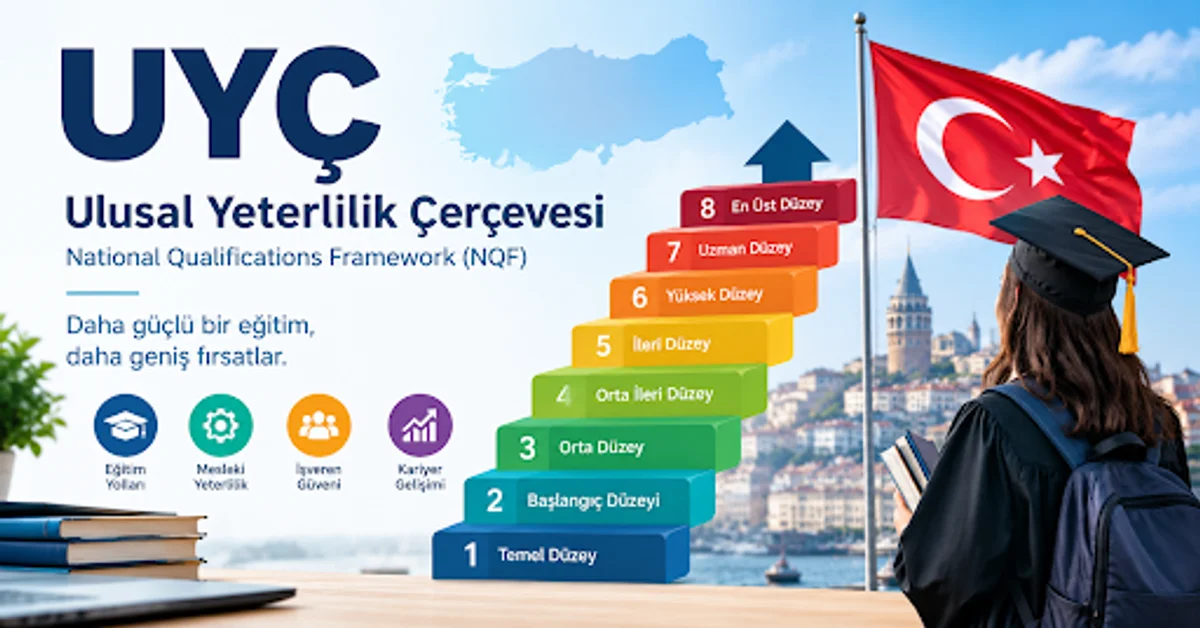
UYÇ is a Turkish term that translates to National Qualifications Framework (NQF) in English. It refers to the concept of organizing educational and vocational qualifications according to their learning outcomes, knowledge, skills, and competencies. In Turkey, the official national framework is called Türkiye Yeterlilikler Çerçevesi (TYÇ), which brings recognized qualifications from different educational pathways into a structured system.
The purpose of UYÇ and TYÇ is to make qualifications easier to understand, compare, and evaluate. The framework helps students plan their education, employers understand applicants’ skills, and educational institutions assess learning achievements. Turkey’s TYÇ framework has eight levels, ranging from foundational learning outcomes to advanced knowledge and expertise. Although it is aligned with the European Qualifications Framework (EQF), this alignment does not automatically guarantee international degree recognition, university admission, or professional licensing.
A national qualifications framework makes educational achievements easier to understand. A certificate from a vocational training program and a university degree may have different purposes, but a framework can describe their learning levels using consistent criteria. This supports clearer communication between learners, educational institutions, and employers.
The framework also encourages skills development and lifelong learning. People can acquire knowledge through formal education, vocational education and training, workplace experience, or other learning opportunities. Where the relevant assessment and recognition arrangements apply, these achievements can be considered within a structured qualifications system.
Related: Uncuymaza: Meaning, Origin, and Complete Guide
The History and Development of UYÇ and TYÇ
How Turkey Developed Its Qualifications Framework
Countries establish national qualifications frameworks to improve consistency across education and training systems. Turkey developed TYÇ to bring together qualifications that had been designed and awarded through different institutions and learning pathways. The framework’s implementation rules entered into force in November 2015, followed by publication of the framework in January 2016.
The development process involved public authorities, education institutions, vocational bodies, social partners, experts, and other relevant stakeholders. The goal was to create a common system for describing qualification levels, improving quality assurance, and supporting progression between learning pathways. This also helped establish a clearer relationship between national qualifications and international reference frameworks.
The Role of TYÇ in the Turkish Education System
TYÇ serves as Turkey’s official national qualifications framework. It covers recognized qualifications associated with primary and secondary education, higher education, vocational education, and other relevant learning pathways. The framework is designed to bring these achievements together without replacing the institutions that award qualifications.
Several institutions have important responsibilities within the system. The Ministry of National Education oversees areas of education within its authority, while the Council of Higher Education (YÖK) has responsibilities relating to higher education. The Vocational Qualifications Authority (MYK) also plays a central role in vocational qualifications and coordination of the framework.
How the Turkish Qualifications Framework Works
Understanding Learning Outcomes and Competencies
Learning outcomes are statements describing what a learner is expected to know, understand, or be able to do after completing a learning activity or qualification. They are central to the Turkish qualifications framework because they provide a consistent way to describe educational achievement.
These outcomes can include theoretical knowledge, technical skills, practical competencies, problem-solving abilities, and the capacity to take responsibility. For example, a vocational qualification may require someone to demonstrate a specific workplace skill, while an advanced academic qualification may emphasize research, critical analysis, and independent problem-solving. The expected outcomes depend on the qualification and its level.
How Qualifications Are Evaluated and Classified
Qualification assessment involves examining the outcomes associated with a qualification and comparing them with the framework’s level descriptors and applicable requirements. These descriptors help explain the expected knowledge, skills, and competencies at each level. Quality assurance also matters because the framework is intended to include qualifications that meet relevant standards.
The process does not mean that every certificate automatically receives a TYÇ level. Qualifications must satisfy the applicable inclusion criteria and procedures. This distinction helps maintain the framework’s credibility and prevents the assumption that any course certificate represents a nationally recognized qualification. The official framework documentation explains its structure, level descriptors, and arrangements for including qualifications.
Understanding the Eight Levels of the TYÇ Framework
Knowledge, Skills, and Responsibilities Across the Levels
The Türkiye Qualifications Framework contains eight levels, numbered from Level 1 to Level 8. These levels describe progressively more complex learning outcomes, ranging from foundational knowledge and the ability to carry out basic tasks to advanced expertise, innovation, and the ability to address complex problems.
Three important dimensions help describe the levels: knowledge, skills, and competence. Knowledge concerns understanding facts, principles, and concepts. Skills involve applying knowledge to tasks and problems. Competence includes applying learning with an appropriate degree of independence and responsibility. The precise expectations vary by level and qualification.
How Qualification Levels Relate to Education and Careers
Qualification levels help learners and employers understand the general complexity of learning represented by a qualification. They can support educational planning, career development, and comparisons between different types of qualifications. For instance, a learner may use framework information to explore further training or understand how an existing qualification fits into a broader national structure.
However, it is important not to treat the eight levels as a simple list of school grades or job ranks. A qualification’s level depends on its learning outcomes and relevant assessment, not merely on how long a course lasts or how prestigious its title sounds. Two qualifications at the same level may cover different subjects, prepare learners for different professions, and have different admission or employment requirements.
UYÇ, TYÇ, and the European Qualifications Framework (EQF)
Key Differences Between UYÇ, TYÇ, and EQF
Although these terms are related, they have different meanings. UYÇ refers to the general concept of a national qualifications framework. TYÇ is Turkey’s specific national framework, while the European Qualifications Framework (EQF) is a shared European reference framework that helps make qualifications easier to compare across participating countries.
The distinction matters because UYÇ is not the name of a separate Turkish diploma or a qualification awarded to individuals. TYÇ is the official framework used to organize Turkish qualifications. The EQF, meanwhile, provides a reference for comparing qualification levels across national systems without replacing their individual education policies or qualification structures.
How International Qualification Comparisons Work
Turkey referenced TYÇ to the EQF in 2017 and updated its referencing report in 2025. This work helps explain the relationship between the national framework’s levels and the European framework’s level descriptors. Turkey also participates in the Bologna Process and the wider European Higher Education Area, which support cooperation and transparency in higher education.
This alignment can help universities, employers, and learners understand the general level of a Turkish qualification when considering international opportunities. Nevertheless, comparison is not the same as automatic equivalency. A foreign university, employer, or professional authority may still review the qualification’s content, accreditation, learning outcomes, and compliance with local requirements.
Benefits of UYÇ for Students, Employers, and Institutions
How Students and Graduates Benefit From Qualification Transparency
For students, TYÇ offers a clearer way to understand qualifications and explore future learning opportunities. Its structure can help learners identify the general level of a qualification, consider possible progression routes, and understand how different education and training pathways fit into the national system.
Graduates can also use framework information when explaining their academic or vocational achievements. This may be useful when preparing applications for further study or employment. However, students should always check the specific admission rules, credit-transfer policies, and recognition requirements of the institution they plan to approach.
Why Employers and Universities Use Qualifications Frameworks
Employers need to understand applicants’ knowledge, practical skills, and professional competencies. A qualifications framework can help by describing learning outcomes in a structured way rather than relying only on the title of a certificate. This can contribute to clearer recruitment discussions and better understanding of different educational backgrounds.
Universities and training providers can also use qualification descriptions to inform curriculum development, progression planning, and the evaluation of prior learning. Frameworks encourage communication between education and employment stakeholders, although individual organizations remain responsible for their own admission, recruitment, and assessment decisions.
UYÇ and International Qualification Recognition
Comparing Turkish Qualifications With Foreign Qualifications
International qualification recognition is important for students who want to study abroad and graduates seeking opportunities in another country. TYÇ and its relationship with the EQF can help institutions understand the general level of a Turkish qualification and compare it with qualifications in other systems.
For example, someone applying to a foreign university may use official qualification documents and framework information to explain their educational background. The receiving institution may then examine the awarding institution, program content, accreditation, academic records, and other relevant requirements. TYÇ supports transparency, but it does not independently decide whether a foreign qualification is equivalent to a Turkish degree or vice versa.
Professional Licensing and Recognition Requirements Abroad
Some professions require more than an academic degree or vocational certificate. Medicine, nursing, teaching, and other regulated occupations may involve licensing examinations, language requirements, supervised practice, or registration with a relevant authority.
Anyone considering employment abroad should check the rules of the destination country and the professional regulator responsible for their occupation. Academic degree recognition, professional licensing, and employment eligibility are separate matters. Understanding these differences helps graduates plan their next steps with realistic expectations.
Who Uses UYÇ and the Türkiye Qualifications Framework?
The Role of Government and Education Authorities
Government institutions help maintain the standards and coordination needed for a national qualifications system. In Turkey, the Ministry of National Education, the Council of Higher Education (YÖK), and the Vocational Qualifications Authority (MYK) have important responsibilities within their respective areas.
The framework also connects with broader international education initiatives. Organizations such as UNESCO and the European Centre for the Development of Vocational Training (Cedefop) contribute to international discussion, research, and information about qualifications systems. Related concepts include the International Standard Classification of Education (ISCED), which classifies education programs and qualifications for statistical comparison; it is not the same as TYÇ.
How Training Providers and Employers Apply the Framework
Educational institutions and vocational training providers can use learning outcomes and qualification standards to describe what learners should achieve. This supports the design of educational programs and helps clarify the knowledge and competencies associated with different qualifications.
Employers can use this information as one part of evaluating candidates, while training organizations may use it to explain progression opportunities. The framework is also relevant to lifelong learning because people develop skills through education, professional experience, and additional training throughout their working lives. Recognition of prior learning, where available under the relevant procedures, can help make these achievements more visible.
Limitations and Common Misunderstandings About UYÇ
Does a Qualification Level Guarantee International Recognition?
No. A qualification’s framework level does not automatically guarantee admission to a university, employment in another country, or authorization to work in a regulated profession. TYÇ’s alignment with the EQF helps clarify qualification levels, but recognition decisions remain subject to the applicable national rules and institutional requirements.
Learners should verify whether their particular qualification is recognized, whether additional documents are required, and whether translation or authentication is necessary. Checking with the receiving university, employer, or competent authority before applying can save time and prevent misunderstandings.
UYÇ vs. TYÇ: Clearing Up Common Confusion
The main UYÇ and TYÇ difference is that UYÇ describes the general concept of a National Qualifications Framework, whereas TYÇ is the official name of Turkey’s own framework. Both terms relate to organizing qualifications, but they should not be presented as two separate Turkish systems without evidence.
Another common misconception is that all qualifications at the same level are equivalent in subject matter. In reality, the levels describe broad learning outcomes and complexity, not identical curricula or professional rights. Understanding this distinction helps students, graduates, and employers use framework information accurately.
Related: Soutaipasu: Meaning, Uses, and Relative Paths Explained
Frequently Asked Questions
What does UYÇ stand for?
UYÇ stands for Ulusal Yeterlilik Çerçevesi, which translates to National Qualifications Framework in English. It refers to the system used to organize educational and vocational qualifications according to learning outcomes and competencies.
What is the difference between UYÇ and TYÇ?
UYÇ is the general term for a National Qualifications Framework, while TYÇ (Türkiye Yeterlilikler Çerçevesi) is Turkey’s official national framework for organizing recognized qualifications.
How many levels does the Turkish Qualifications Framework have?
The Türkiye Qualifications Framework (TYÇ) has eight levels. These levels describe increasing complexity in knowledge, skills, and competencies, from foundational learning to advanced expertise.
Is TYÇ aligned with the European Qualifications Framework (EQF)?
Yes, TYÇ has been referenced to the European Qualifications Framework (EQF). This connection helps people compare qualification levels across countries, but it does not guarantee automatic recognition of every qualification.
Why is UYÇ important for students and employers?
UYÇ-related frameworks help students understand educational pathways and plan further studies. Employers can use qualification information to better understand applicants’ knowledge, practical skills, and professional competencies when evaluating candidates.
Summary
UYÇ represents the concept of a National Qualifications Framework, while Türkiye Yeterlilikler Çerçevesi (TYÇ) is Turkey’s official framework for organizing recognized educational and vocational qualifications. Its eight levels provide a structured way to understand learning outcomes, practical skills, and professional competencies. By making qualifications easier to compare, the framework helps students plan their education, enables employers to better understand applicants’ abilities, and supports educational institutions in evaluating learning achievements. Its connection with the European Qualifications Framework (EQF) also improves transparency when comparing qualifications across different countries.
As education and employment opportunities continue to expand, UYÇ and TYÇ remain valuable references for lifelong learning and career planning. Whether you want to pursue higher education, improve your professional skills, or explore opportunities abroad, understanding the framework can help you make informed decisions. However, qualification levels alone do not guarantee international recognition, university admission, or professional licensing. Always verify your qualification’s official status and check the relevant institution’s requirements before taking the next step. With accurate information and careful planning, you can use Turkey’s qualifications framework to navigate your educational and professional journey more confidently.



[…] Related: UYÇ: Meaning, Levels, and Importance Explained […]
[…] Related: UYÇ: Meaning, Levels, and Importance Explained […]