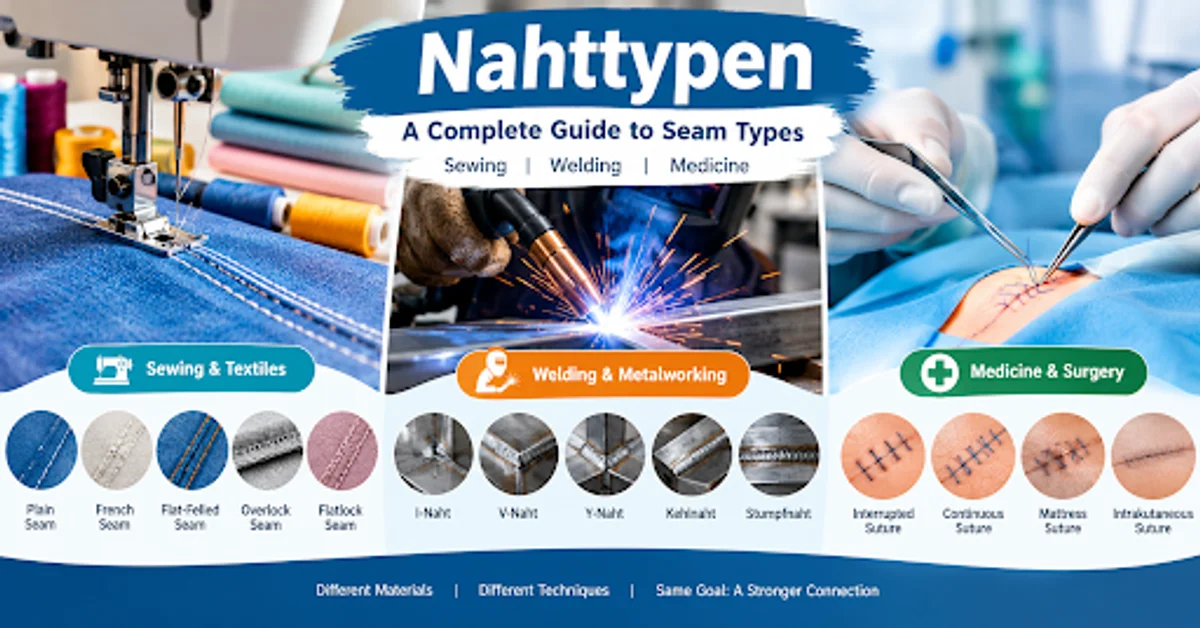
Nahttypen is a German plural term that can be translated as “seam types,” “weld types,” or “suture types,” depending on the subject. The word combines Naht, which can refer to a seam, joining line, weld, or suture, with Typen, meaning types. Therefore, its basic idea is a group of different ways in which two parts are joined. The Nahttypen Bedeutung becomes clearer when the surrounding subject is considered. In sewing, it normally describes different ways of joining fabric. In welding and metalworking, it can describe forms of welded joints or weld seams. In medicine, it can refer to different suture techniques used for wound closure.
The most suitable Nahttypen Englisch translation is not always the same. In a sewing article, “seam types” is usually the natural choice. In a welding manual, “weld types” or “joint types” may be more accurate. In a medical context, “suture types” or “suture techniques” is generally appropriate. This makes Nahttypen Übersetzung a context-dependent process rather than a simple word-for-word exercise. Someone searching for Nahttypen Deutsch, Nahttypen Definition, or was sind Nahttypen should therefore look at the industry in which the term appears.
A Naht always involves some form of joining, but the materials and purpose can be completely different. A seam in a shirt is designed for flexibility and appearance, while a weld joins metal components and must meet engineering requirements. A surgical suture, meanwhile, is used in a controlled medical procedure. Understanding this distinction prevents misleading translations. The surrounding vocabulary usually provides useful clues: words such as Stoff and Nähmaschine point toward textiles, while Schweißnaht and Schweißfuge indicate welding. Terms such as Wundverschluss, Gewebe, and Chirurgie point toward medicine.
Related: Inbredward: The Story Behind the Squidward Meme
Nahttypen in Sewing and Textiles
Common Sewing Seam Types
In sewing, Nahttypen beim Nähen describes the different ways pieces of fabric are joined. A seam can influence strength, flexibility, appearance, comfort, and durability. This makes the correct Nahtart an important part of garment construction.
Common examples include the Einfache Naht, French seam, Kappnaht, Overlocknaht, and Flatlocknaht. Each has a particular construction and practical purpose. Some hide raw fabric edges, while others prioritize strength, stretch, speed, or a smooth finish.
The term seam types in sewing is therefore broader than simply describing different stitch patterns. Seam construction and stitch type are related but are not identical concepts. ISO 4916:1991 provides an international classification and terminology system for stitched seam types in textiles and remains a current confirmed standard.
Choosing a Seam for Different Fabrics
The right seam depends on the Stoff, garment design, expected stress, and desired appearance. Lightweight fabrics may benefit from a clean enclosed seam, while heavier materials such as Denim can require stronger construction. Stretch materials may need a seam that accommodates movement without creating excessive bulk.
A skilled Schneider or sewing professional considers the complete garment rather than choosing a seam in isolation. Factors such as seam allowance, fabric thickness, edge fraying, stretch, and the position of the seam can all affect the final result.
For manufacturers, this decision is especially important because consistent Nahtqualität supports reliable Bekleidung production. A well-selected seam can improve comfort and durability while creating a cleaner finish.
Common Nahttypen Used in Sewing
Plain Seam and French Seam
The Einfache Naht, commonly translated as a plain seam, is one of the most familiar Nähte Arten. Two fabric pieces are placed together and stitched along their edges. It is versatile and can be used for many everyday garments and sewing projects.
A Französische Naht, or French seam, encloses the raw edges within the construction. This produces a neat appearance and can be especially useful for lightweight or delicate fabrics where exposed edges may detract from the finished garment.
Both demonstrate an important principle of Nahtkonstruktion: a seam is selected not only to connect fabric but also to achieve a particular finish and level of durability.
Flat Felled, Overlock, and Flatlock Seams
The Kappnaht, commonly known as a flat-felled seam, creates a strong and enclosed construction. It is associated with garments that need durable seams, including certain workwear and denim products. Its finished appearance also makes it useful where the inside of a garment should look clean.
An Overlocknaht uses threads around the fabric edge to join and/or finish material. An Overlock machine can perform this operation efficiently, making it particularly valuable in clothing production. A Flatlock seam is constructed to lie relatively flat and can be useful in garments where reducing bulk or rubbing is desirable.
These examples show why verschiedene Nahttypen are valuable. No single seam is perfect for every material or garment. Good Nähtechnik matches construction with purpose.
Nahttypen in Welding and Metalworking
Weld Types and Joint Forms
In welding, Nahttypen can refer to different forms of welded connections. The exact English terminology depends on whether the discussion concerns the joint geometry, groove preparation, or resulting Schweißnaht.
During Schweißen, metal components may meet edge-to-edge, overlap, or meet at an angle. The resulting joint arrangement influences how the connection is prepared and welded. This is why technical drawings and welding specifications are important when interpreting German terminology.
Unlike textile sewing, welding involves high temperatures and specialized industrial processes. Metallverarbeitung therefore relies on precise terminology so that designers, fabricators, inspectors, and welders understand the intended connection.
I-Naht, V-Naht, and Y-Naht
An I-Naht generally refers to an I-shaped or square-groove preparation, while a V-Naht uses a V-shaped groove. A Y-Naht describes a Y-shaped groove arrangement. The precise construction and application depend on the material, thickness, welding process, and engineering specification.
These terms are examples of why Nahttypen Erklärung requires technical context. The shape of a Schweißfuge is not merely a naming detail; it can influence preparation and access for the welding process.
In professional fabrication, weld terminology should always be interpreted alongside the relevant drawing, standard, procedure, or specification. A dictionary translation alone may not communicate the complete technical meaning.
Common Welding Nahttypen
Fillet Weld and Butt Weld
A Kehlnaht is commonly translated as a fillet weld. It is widely used where components meet at an angle, such as certain T-joints and lap configurations. The weld forms approximately triangular geometry between the connected surfaces.
A Stumpfnaht, by contrast, is associated with a butt joint, where components are positioned substantially edge-to-edge. The preparation can vary according to material thickness and welding requirements.
Both are important welding seam types, but their applications and preparation are not interchangeable. Engineers and fabricators select the appropriate connection based on design requirements and manufacturing conditions.
Lap Joints and Other Weld Forms
An Überlappnaht describes a lap-style connection in which one component overlaps another. Lap joints can be useful in sheet-metal fabrication and other manufacturing situations because the components can be positioned with overlapping surfaces.
The broader category of Fügeverfahren includes many ways of connecting materials, and welding is only one part of that larger technical field. The exact Nahttypen used in a project depend on design, material, thickness, load requirements, accessibility, and applicable standards.
For that reason, technical professionals should use the terminology specified by the relevant engineering documentation instead of assuming that every German term has one universal English equivalent.
Nahttypen in Medicine and Surgery
Suture Types and Techniques
In medicine, Nahttypen can refer to suture types or suture techniques. A Suture is used to approximate tissue during wound closure or surgery. Different techniques allow clinicians to manage wound edges and tissue according to the particular clinical situation.
Examples include the Einzelknopfnaht, Fortlaufende Naht, Matratzennaht, and Intrakutannaht. The choice is made by qualified medical professionals according to factors such as wound characteristics, tissue, tension, location, and the overall clinical objective.
Surgical wound closure is only one part of safe surgical care. The World Health Organization’s evidence-based guidelines address surgical-site infection prevention across the preoperative, intraoperative, and postoperative periods.
Interrupted and Continuous Sutures
An Einzelknopfnaht is an interrupted technique in which individual stitches are placed and secured separately. A Fortlaufende Naht uses a continuous strand through a sequence of stitches. Each approach has practical advantages and limitations, so the appropriate choice depends on the wound and clinical circumstances.
Evidence reviews have compared continuous and interrupted skin sutures, showing that the relative benefits can vary according to the situation rather than establishing one universally superior method.
This distinction is important because Nahttypen in medicine should not be treated as a simple ranking of “best” and “worst.” Surgical decisions require professional assessment and appropriate technique.
Common Medical Nahttypen
Mattress and Subcuticular Sutures
A Matratzennaht is a mattress suture. Mattress techniques can be oriented vertically or horizontally and are used for particular wound-closure requirements. The Donati-Naht is a well-known form associated with vertical mattress suturing.
An Intrakutannaht is generally described as a subcuticular or intradermal technique, with the suture placed within the skin layers rather than passing repeatedly through the visible outer surface. Such techniques may be selected when the appearance of the closure is an important consideration.
These are specialized medical techniques and should be performed only by appropriately trained healthcare professionals. Their selection depends on clinical judgment rather than on the name of the technique alone.
Factors That Influence Suture Selection
Suture selection can depend on wound location, tissue characteristics, tension, contamination, healing expectations, and the desired method of closure. The clinician also considers the Nahtmaterial and whether a suture should remain temporarily or be absorbed by the body.
WHO guidance emphasizes appropriate wound assessment and careful closure as part of safe surgical care. Its guidance describes several established closure approaches, including interrupted, continuous, mattress, and intradermal techniques.
The key lesson is that medical Nahttechnik should always be considered within the complete clinical context. A technique that is useful in one situation may not be appropriate in another.
How to Translate Nahttypen Correctly
Nahttypen Translation by Industry
The simplest way to achieve an accurate Nahttypen Übersetzung is to identify the industry first. In textiles, translate it as seam types. In welding, weld types or joint types may be appropriate. In medicine, suture types or suture techniques usually communicate the intended meaning more naturally.
This approach also helps with related searches such as Nahttypen Englisch, Nahttypen Bedeutung, and Nahttypen Erklärung. Instead of relying on a single dictionary definition, readers can match the translation to the subject.
German and English Technical Terms
Technical German often contains compact terms that become more specific when translated. For example, Französische Naht becomes French seam, Kappnaht becomes flat-felled seam, Kehlnaht becomes fillet weld, and Einzelknopfnaht becomes interrupted suture.
The best translation preserves both the literal concept and the technical meaning. This is especially important for manuals, educational material, manufacturing specifications, and medical documents where an inaccurate term could create confusion.
Why Nahttypen Matter in Different Industries
Importance in Textile Production
In the Textilindustrie, seam selection affects construction, appearance, durability, comfort, and production efficiency. Clear terminology allows designers, pattern makers, sewing teams, and manufacturers to communicate consistently.
International classification also improves communication across manufacturing environments. ISO 4916 specifically classifies and illustrates different stitched seam types, while ISO 4915 covers stitch types used in hand- and machine-sewn seams.
Importance in Welding and Healthcare
In welding, precise terminology helps professionals understand joint geometry and fabrication requirements. In healthcare, accurate terminology helps clinical teams communicate about wound closure and surgical procedures.
Although the applications are very different, the underlying concept remains similar: Nahttypen describes organized ways of joining or closing something. Recognizing that common idea makes this German term much easier to understand.
Related: Messonde: Meaning, Uses, and How It Works
Frequently Asked Questions
What does Nahttypen mean?
Nahttypen is a German term meaning “types of seams” or different joining methods.
What is Nahttypen in English?
In sewing, Nahttypen is usually translated as “seam types.”
What are common Nahttypen in sewing?
Common examples include the plain seam, French seam, flat-felled seam, overlock, and flatlock.
Do Nahttypen apply to welding?
Yes. In welding, it can refer to different weld or joint types.
Does Nahttypen have a medical meaning?
Yes. In medical contexts, it can refer to different suture types or techniques.
Summary
Nahttypen is a useful German technical term with a surprisingly broad meaning. Its basic concept involves different ways of joining, connecting, or closing parts, but the correct English translation changes according to the field.
In sewing and textiles, it refers to seam types such as the Einfache Naht, Französische Naht, Kappnaht, Overlocknaht, and Flatlocknaht. In welding, it can describe forms such as I-Naht, V-Naht, Y-Naht, Kehlnaht, Stumpfnaht, and Überlappnaht. In medicine, it can refer to suture types including interrupted, continuous, mattress, and intrakutaneous techniques.
Understanding the context is therefore the key to an accurate Nahttypen Übersetzung. Whether the subject is Nähen, Textilindustrie, Metallverarbeitung, Schweißen, or Chirurgie, the right terminology makes technical information clearer, more reliable, and easier to use.
Editorial note: This article is intended as an educational language and terminology guide. Textile terminology is aligned with the current ISO 4916 seam-classification reference, while medical statements are presented at a general informational level and supported by established WHO and medical literature.



[…] Related: Nahttypen: A Complete Guide to Seam Types […]
[…] Related: Nahttypen: A Complete Guide to Seam Types […]