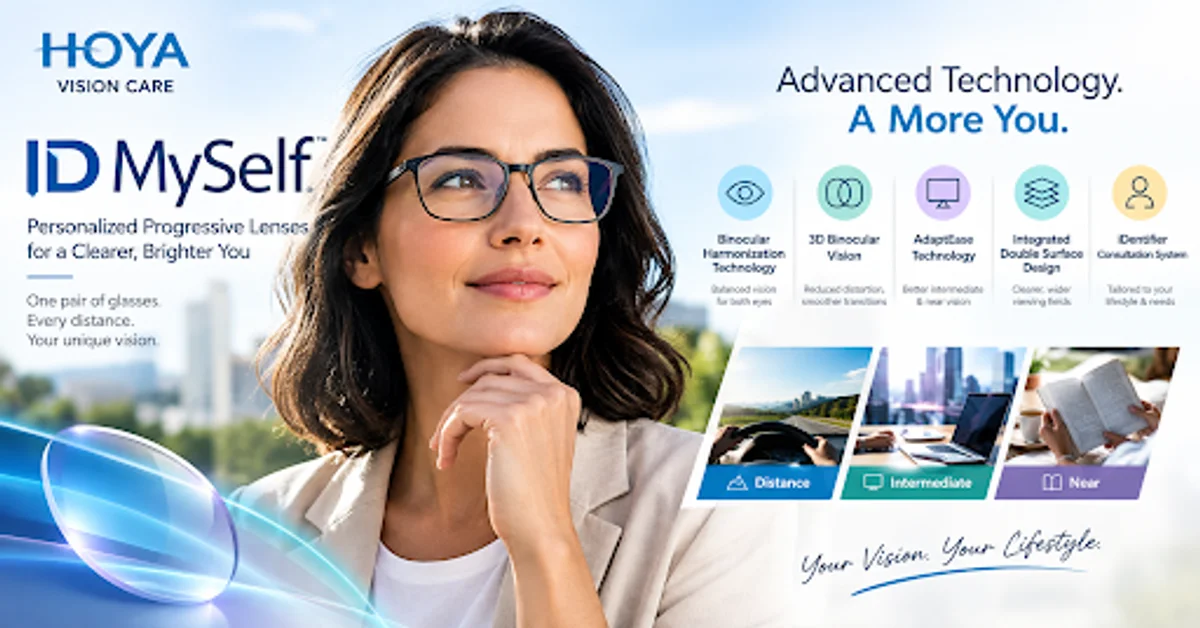
ID MySelf is a premium progressive lens design from HOYA Vision Care, developed for people with presbyopia who need clear vision across distance, intermediate, and near ranges. It belongs to the Hoyalux family of Progressive lens and focuses on creating a more individualized visual experience rather than relying on one general design for every wearer. HOYA describes the lens as being tailored to individual visual needs, with technologies intended to improve adaptation, binocular performance, and useful visual fields.
Progressive lens are designed to provide multiple viewing distances without the visible dividing line found in traditional bifocals. The upper portion generally supports distance vision, the middle supports intermediate tasks, and the lower area supports near vision. This makes them useful for people who regularly move between driving, reading, computer work, smartphones, and other everyday activities. Presbyopia is commonly managed with corrective eyewear, including Progressive lens, making personalized lens design an important option for people seeking one pair of glasses for multiple distances.
Related: Nahttypen: A Complete Guide to Seam Types
How Does ID MySelf Work?
The central idea behind the ID MySelf lens design is personalization. Instead of considering only the optical prescription, the lens can take individual visual requirements and fitting information into account. HOYA’s iDentifier consultation system is designed to help eye-care professionals understand the wearer’s needs and individualize the lens selection.
This approach matters because two people with similar prescriptions may have very different lifestyles. One person may spend much of the day working at a computer, while another may drive frequently, read printed material, move around outdoors, or constantly switch between near and far objects. A customized progressive lens aims to organize the viewing zones around those practical demands.
Why Personalized Progressive lens Matter
A progressive lens has to provide a useful balance between distance, intermediate, and near vision. Unlike a single-vision lens, it contains different power areas across the lens surface. As a result, the wearer’s experience can depend not only on the optical prescription but also on lens design, frame selection, fitting measurements, and how the wearer naturally looks through the lenses.
Personalized Progressive lens are particularly relevant when a wearer has specific visual priorities. Someone who spends long periods using digital devices may value a generous intermediate zone, while an active person may place greater importance on stable distance vision. The goal is not simply to make a lens more complicated, but to make its optical performance more relevant to the person’s daily routine.
Key Technologies Behind ID MySelf
HOYA ID MySelf combines several technologies designed to address common challenges associated with progressive eyewear. According to HOYA, these include Binocular Harmonization Technology, 3D Binocular Vision, AdaptEase Technology, Integrated Double Surface Design, and the iDentifier consultation system.
These technologies address different parts of the progressive-lens experience. Some focus on binocular balance, while others are intended to reduce peripheral distortion, support adaptation, or improve near and intermediate viewing fields. Together, they form the foundation of the ID MySelf progressive lens technology.
Binocular Harmonization Technology
Binocular Harmonization Technology is designed around the fact that the two eyes do not always have identical optical prescriptions. HOYA states that its historical European progressive lens order data found that 73% of presbyopes had different prescriptions between their right and left eyes. The company says this technology balances differences in additional power between the two eyes.
The practical objective is to support coordinated binocular vision. When both eyes work together comfortably, focusing and depth perception can feel more natural. This is especially relevant in Progressive lens because the wearer is continually shifting gaze through different areas of the lenses.
3D Binocular Vision
Peripheral distortion is one of the challenges associated with progressive lens design. Although the central viewing areas can provide clear vision, unwanted optical effects toward the sides may create blur or a sense of movement when the wearer turns the head or changes gaze.
HOYA says its 3D Binocular Vision technology controls unwanted prismatic effects in the peripheral areas of the lens. The company’s product information states that this approach is intended to reduce distortion and swaying effects while supporting easier adaptation.
For a wearer, the technical explanation is less important than the intended experience: smoother visual transitions and less distracting peripheral effects. However, individual results can vary, and accurate prescription and fitting remain essential.
AdaptEase and Intermediate Vision
AdaptEase Technology is another important component of ID MySelf. HOYA says it improves near and intermediate visual width and supports smoother gaze transitions without compromising far vision. The company also specifically identifies an optimized intermediate field for digital-device use.
Intermediate vision has become increasingly important because many everyday tasks happen between traditional reading distance and far-distance viewing. A laptop, desktop monitor, dashboard, kitchen counter, or phone held at a comfortable distance can require a different viewing range. A progressive lens with strong intermediate support can therefore be valuable for people with a digital lifestyle.
The ID MySelf for computer use concept should not be confused with a dedicated occupational or office lens. ID MySelf is still a general progressive design intended to provide vision across multiple distances. People with highly specific workstation requirements may need to discuss occupational lenses with their optician.
ID MySelf Profiles for Different Lifestyles
The ID MySelf lens profiles are intended to recognize that progressive-lens users do not all have identical visual priorities. HOYA’s profile range includes options designed around different patterns of visual activity. The company currently describes Stable, Detail, and Expert profiles on its product information, while regional materials may present the range differently.
This lifestyle-based approach can make lens selection more meaningful. Rather than choosing a design based only on prescription strength, the optician can consider how frequently the wearer changes focus and which distances are most important during the day.
Adventure, Stable, Detail, and Expert
The Adventure profile is presented as an option for people who place greater emphasis on distance vision and active, outdoor viewing. It can therefore be relevant to wearers who spend substantial time looking across open spaces or engaging in activities where far vision is particularly important.
The Stable profile is intended for people who frequently change focus across near, intermediate, and far distances. Detail is designed for wearers who spend considerable time indoors or require strong close and intermediate clarity. Expert is aimed at experienced progressive-lens wearers who frequently move between distant and close viewing. HOYA notes that profile availability can vary by market.
Who Can Benefit From ID MySelf?
The people most likely to consider ID MySelf personalized lenses are presbyopic adults who want one pair of glasses for multiple distances and place a high value on individualized visual performance. It may be particularly interesting for people who frequently use computers, smartphones, printed material, and distance vision throughout the same day.
Experienced progressive-lens wearers may also appreciate personalization because they often know exactly what they want to improve. For example, someone may already be comfortable with distance vision but want a broader intermediate area, while another wearer may be more concerned about peripheral distortion or adaptation.
That does not mean premium Progressive lens are automatically necessary for everyone. A conventional progressive design can work very well for many people. The value of ID MySelf depends on individual needs, prescription, fitting, lifestyle, and budget.
Fitting, Measurements, and Frame Selection
Even the most advanced ID MySelf glasses depend on accurate lens fitting. Progressive lens require the viewing zones to be positioned appropriately in relation to the wearer’s eyes. Measurements can include pupil position, fitting height, frame size, frame tilt, and other optical parameters relevant to the final position of the lens.
Frame selection is also important. A frame needs to be suitable for the selected progressive design and provide appropriate lens depth. The way the frame sits on the face can influence how the wearer accesses different viewing zones.
This is why the buying process should involve more than asking about ID MySelf lens price or ID MySelf cost. The complete result depends on the prescription, lens material, coatings, frame, measurements, fitting, and optical practice. A qualified eye-care professional can explain which factors apply to an individual order.
ID MySelf vs Standard Progressive lens
The difference between ID MySelf vs standard Progressive lens is primarily the degree and type of personalization. Standard Progressive lens are designed to provide a broad solution for many wearers, while ID MySelf incorporates additional individualized considerations and technologies.
HOYA describes ID MySelf as a tailor-made progressive lens using binocular technologies, AdaptEase, Integrated Double Surface Design, lifestyle customization, and its iDentifier consultation tool.
A premium design can be especially interesting for someone with demanding visual habits or previous difficulty adapting to Progressive lens. However, product sophistication does not replace good clinical measurements or professional fitting. The most appropriate lens is ultimately the one that matches the wearer’s prescription and actual visual requirements.
Is ID MySelf Right for You?
Whether ID MySelf is suitable depends on what you expect from your everyday eyewear. If you have presbyopia and regularly move between distance, intermediate, and near tasks, a personalized progressive lens may offer useful advantages worth discussing with an optician.
The design is particularly relevant to modern visual routines involving digital devices, reading, driving, outdoor activities, and frequent changes in viewing distance. HOYA specifically highlights improved near and intermediate visual fields, digital-device use, adaptation, and binocular performance as key aspects of ID MySelf.
At the same time, expectations should remain realistic. No progressive lens eliminates every optical limitation, and individual results can differ. Prescription accuracy, visual acuity, frame choice, fitting measurements, and adaptation all contribute to the final experience.
Related: Sosoactive Co: A Complete Guide to the Platform
Frequently Asked Questions
What are ID MySelf lenses?
ID MySelf lenses are personalized Progressive lens from HOYA’s Hoyalux range. They are designed to provide distance, intermediate, and near vision while incorporating technologies intended to improve binocular performance, adaptation, and visual comfort.
Are ID MySelf lenses good for computer use?
HOYA specifically describes an optimized intermediate field for comfortable digital-device use. This can make the design relevant to people who regularly use laptops, monitors, and other screens.
What makes ID MySelf different from regular Progressive lens?
The design emphasizes individualization and combines technologies such as Binocular Harmonization, 3D Binocular Vision, AdaptEase, and Integrated Double Surface Design.
How much do ID MySelf lenses cost?
The ID MySelf lens price can vary depending on location, prescription, lens material, coatings, frame, and optical provider. It is better to compare the complete fitted package rather than the lens name alone.
Do ID MySelf lenses require an adjustment period?
Progressive lens can require adaptation, although HOYA specifically designed AdaptEase Technology to support easier and faster adaptation. Individual adjustment experiences vary.
Summary
ID MySelf represents a modern approach to progressive lens personalization. Instead of treating every wearer the same, its design considers binocular vision, lifestyle, fitting, and the practical demands of moving between different viewing distances.
Its combination of Binocular Harmonization Technology, 3D Binocular Vision, AdaptEase Technology, Integrated Double Surface Design, and iDentifier gives the product a strong focus on individualized optical performance.
For someone looking for premium Progressive lens that can support distance vision, intermediate tasks, reading, and digital-device use in one pair of glasses, ID MySelf may be worth discussing with an eye-care professional. The final decision should be based on a current optical prescription, accurate measurements, frame suitability, lifestyle needs, and professional advice rather than the product name alone.