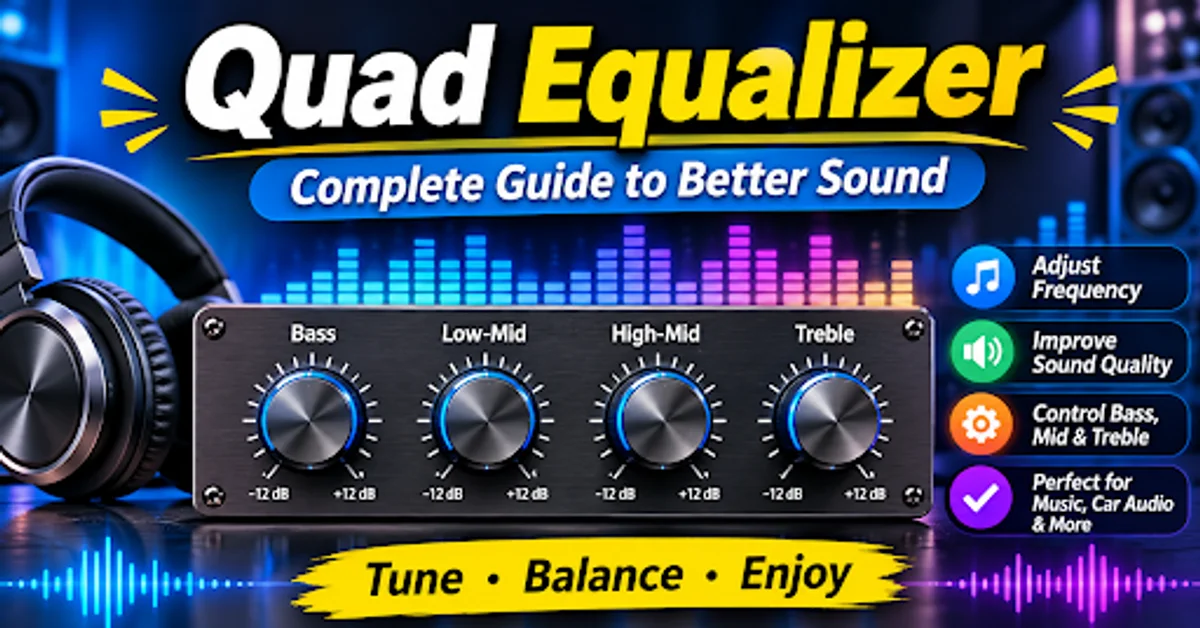
A quad equalizer is an audio-processing tool that lets users adjust four frequency bands: bass, low-mid, high-mid, and treble. It provides greater control over sound than basic bass-and-treble controls, making it useful for music production, home audio, car stereos, and guitar amplifiers.
The primary purpose of a quad equalizer is to improve tonal balance. Instead of simply increasing overall volume, it allows listeners to emphasize desirable frequencies and reduce unwanted sounds. For example, you can make vocals clearer, control excessive bass, or soften sharp high frequencies without changing the entire audio signal equally.
A four-band equalizer offers a practical balance between simplicity and flexibility. A traditional three-band EQ combines the entire middle frequency range into one control, while a 4-band EQ separates it into low-mid and high-mid sections.
This additional control helps users address common audio problems more effectively. You can adjust warmth, vocal presence, and instrument definition independently. It is especially helpful when a recording sounds muddy or when different instruments compete for attention.
Related: Tracqueur: Meaning, Uses, Types, and How It Works
How Does a Quad Equalizer Work?
Understanding Frequency, Gain, and Decibels
Sound consists of vibrations that travel through the air as waves. Their frequency is measured in Hertz (Hz), which describes the number of vibrations per second. Lower frequencies create bass sounds, while higher frequencies contribute to treble and brightness.
A quad equalizer uses gain control to increase or decrease selected frequency ranges. Gain is measured in decibels (dB). A positive value boosts a frequency band, a negative value reduces it, and 0 dB means no adjustment is applied.
For example, reducing a particular frequency range by 2 dB can help control excessive energy without dramatically changing the original recording. Small adjustments are often more effective than extreme settings.
How EQ Adjustments Change Sound Quality
Equalization changes the frequency response of an audio system. Frequency response describes how strongly equipment reproduces different frequencies. Adjusting this response can improve tonal balance and make important musical details easier to hear.
Modern digital quad equalizers use Digital Signal Processing (DSP) to modify audio electronically. Hardware equalizers use electronic circuits to achieve similar results. Both approaches can improve sound, although the outcome depends on the recording, speakers, headphones, listening environment, and equipment quality.
Understanding the Four Frequency Bands
Bass and Low-Mid Frequency Controls
The bass band generally influences low frequencies, often covering approximately 20–250 Hz. It affects deep musical elements such as kick drums, bass guitar, and other low-pitched sounds. Increasing bass can add weight and impact, while reducing it can control excessive rumble.
The low-mid frequency band commonly covers approximately 250 Hz–2 kHz, although actual crossover points vary between devices. This region contributes warmth and body to vocals and instruments. Too much low-mid energy can make music sound boxy or muddy. A modest reduction may help improve separation and overall audio clarity.
High-Mid and Treble Frequency Controls
High-mid frequencies often cover approximately 2–6 kHz. This range contributes to vocal presence, guitar definition, and instrument attack. A small boost can make certain sounds more noticeable, but excessive adjustment may produce harsh or tiring audio.
Treble typically influences the upper frequency range, often around 6–20 kHz. It contributes brightness, air, and fine musical details. Increasing treble can make dull recordings sound more open, while reducing it may soften excessive sharpness or hiss. These frequency ranges are approximate rather than universal standards.
Different Types of Quad Equalizers
Graphic and Parametric Quad Equalizers
A graphic equalizer usually provides four fixed frequency bands, each controlled through a separate slider or knob. Users can quickly increase or decrease the selected ranges without needing advanced audio knowledge. This makes it suitable for everyday listening, basic speaker tuning, and simple sound optimization.
A parametric equalizer provides more detailed control. Depending on the model, users can adjust the center frequency, gain, and Q factor. This flexibility makes it easier to target specific sound problems. A four-band parametric equalizer still has four main bands, but each band can offer considerably more adjustment options.
Semi-Parametric Equalizers and Their Features
A semi-parametric equalizer combines straightforward controls with some additional flexibility. It may allow users to select the frequency and adjust gain without providing complete Q factor control.
This design is common in mixing consoles and some instrument amplifiers. It offers a useful middle ground between simple graphic EQ controls and advanced parametric processing. Brands such as Yamaha and Roland manufacture different types of audio equipment, including products with equalization features. However, specifications vary by individual model.
Key Features of a Quad Equalizer
Frequency, Gain, and Q Factor Controls
Frequency control determines which part of the sound spectrum an equalizer band affects. Gain determines how much that frequency range is boosted or reduced. Together, these controls provide the foundation for adjusting bass, midrange, and treble.
The Q factor determines the bandwidth of an adjustment on equalizers that support it. A lower Q generally affects a wider frequency range, while a higher Q produces a narrower adjustment. This is useful when addressing specific unwanted frequencies without changing too much of the surrounding sound.
EQ Bypass, Filters, and Bandwidth Settings
An EQ bypass switch temporarily disables equalization, allowing users to compare the adjusted signal with the original audio. This feature is valuable because it helps determine whether an adjustment genuinely improves sound quality.
Some advanced equalizers also include bell and shelf filters. A bell filter focuses on a particular frequency region, while a shelf filter adjusts a broader range above or below a selected point. High-pass and low-pass filters can also remove frequencies outside a chosen range. However, these features are not available on every four-band equalizer.
Common Uses of a Quad Equalizer
Quad Equalizer for Music Production and Recording
A quad equalizer for music production helps shape vocals, drums, keyboards, guitars, and bass during recording and mixing. Producers can reduce unwanted low-mid buildup, improve vocal presence, or adjust treble to create a more balanced recording.
Equalization also helps address frequency masking. This happens when overlapping frequency content makes one instrument harder to hear. For example, a guitar and vocal may compete within similar frequency ranges. Carefully adjusting their tonal balance can improve separation.
Professional audio equipment manufacturers such as Shure and Mackie provide tools used in recording and live sound environments. Their products support different audio workflows, including microphone recording, mixing, and sound reinforcement. EQ works best alongside good microphone placement, suitable recording levels, and proper monitoring.
Quad Equalizer for Car Audio and Guitar Amplifiers
A quad equalizer for car audio helps drivers customize the sound produced by vehicle speakers. It can reduce excessive bass, improve vocal clarity, and soften overly bright audio. Since vehicle interiors affect sound reflections and frequency response, the best settings depend on speaker placement and cabin acoustics.
A quad equalizer for guitar amp use provides control over the tonal character of an electric guitar. Guitarists can adjust bass, low-mid, high-mid, and treble to suit different musical styles. For example, reducing excessive low-mid energy may help guitar notes sound more defined when playing alongside a bass guitar.
Quad Equalizer vs. Other Equalizers
Differences Between 3-Band, 4-Band, and 5-Band EQ
A three-band equalizer provides bass, midrange, and treble controls. Its simple design makes it easy to use, but it offers limited control over different sections of the middle frequencies.
A four-band equalizer separates the midrange into low-mid and high-mid sections, providing more flexibility. A five-band EQ adds another adjustment point, allowing users to shape sound in greater detail. However, more frequency bands do not automatically guarantee better audio quality.
Quad Equalizer vs. 10-Band Equalizer
A 10-band equalizer divides the frequency spectrum into more sections, giving users greater control over individual frequency ranges. It can be useful for detailed headphone customization, speaker tuning, and addressing specific tonal problems.
A quad equalizer is generally easier to operate because it uses fewer controls. For everyday listening, car audio, and basic music production, four bands may provide enough flexibility. A 10-band model is more suitable when detailed adjustments are necessary.
The right choice depends on your requirements, equipment, and experience. Simplicity can be more valuable than additional controls when you only need basic tonal adjustments.
Common Quad Equalizer Problems and Solutions
Fixing Muddy Audio, Harsh Vocals, and Weak Bass
Muddy audio can result from excessive bass, crowded low-mid frequencies, poor speaker placement, or recording problems. A small low-mid reduction may help improve separation and definition. However, avoid reducing too much because these frequencies also contribute warmth and body.
Harsh vocals may benefit from carefully reducing problematic high-mid frequencies. If the bass sounds weak, check your speakers and their placement before increasing the bass control. Some systems have limited low-frequency performance, and EQ cannot completely overcome hardware limitations.
Preventing Distortion and Maintaining Sound Balance
Excessive EQ boosts can reduce available headroom and cause clipping when the audio signal exceeds the system’s available digital or analog level. This can introduce unpleasant sound distortion and reduce listening quality.
To prevent this problem, begin with moderate settings and avoid unnecessary boosts. If the sound becomes rough or distorted, reduce the affected gain levels and check the output volume. Cutting unwanted frequencies can sometimes improve clarity without significantly increasing the overall signal level.
Advantages and Limitations of a Quad Equalizer
Main Benefits for Everyday Listening and Audio Mixing
One of the biggest advantages of a quad equalizer is its simplicity. Four separate frequency controls provide enough flexibility to adjust bass, warmth, vocal presence, and treble without overwhelming users with complicated settings.
Another benefit is versatility. A four-band equalizer can be used in headphones, home audio systems, car stereos, recording equipment, and guitar amplifiers. It allows users to customize their listening experience while maintaining control over the original audio character.
For beginners, it provides an accessible introduction to equalization. Experienced audio users can also appreciate its straightforward design when detailed frequency correction is unnecessary.
Limitations and When to Choose an Advanced EQ
Despite its advantages, a quad equalizer cannot address every audio problem. Four bands provide fewer adjustment points than more advanced equalizers. This can make it difficult to target narrow resonances or correct several frequency-related problems independently.
A parametric equalizer with adjustable frequency and Q factor may be a better option for professional audio mixing, mastering, and detailed speaker correction. Advanced models can offer greater precision and flexibility.
It is also important to remember that equalization cannot replace quality recording equipment, suitable speakers, proper microphone placement, or acoustic treatment. Choose an advanced EQ when its additional features solve a real problem rather than simply because it offers more controls.
Related: Hormita: Meaning, Benefits, and Safety Explained
Frequently Asked Questions
What Is a Quad Equalizer Used For?
A quad equalizer adjusts four frequency bands to improve tonal balance. It is commonly used for music production, car audio, headphones, home sound systems, and guitar amplifiers.
What Are the Four Bands of a Quad Equalizer?
The four bands are bass, low-mid, high-mid, and treble. Each controls a different section of the frequency spectrum, although the exact frequency ranges depend on the equipment.
What Are the Best Quad Equalizer Settings?
Start with all four bands at 0 dB. Make small adjustments according to your speakers, recording, and listening preferences. There is no universal setting that works perfectly for every audio system.
Is a Quad Equalizer Better Than a 10-Band EQ?
Neither is universally better. A quad equalizer is simpler and easier to operate, while a 10-band EQ provides more detailed frequency control. Choose according to your audio requirements.
Can a Quad Equalizer Improve Vocal Clarity?
Yes. Carefully reducing excessive low-mid frequencies or adjusting high-mid frequencies can improve vocal definition. The results depend on the recording and playback equipment.
Summary
A quad equalizer is a practical audio tool that provides control over four important frequency areas: bass, low-mid, high-mid, and treble. It helps users improve tonal balance, reduce muddiness, adjust vocal presence, and customize sound for different listening environments.
Its straightforward design makes it useful for beginners, musicians, audio enthusiasts, and recording professionals. Whether you use a graphic equalizer, parametric equalizer, or semi-parametric model, understanding frequency, gain, and bandwidth can help you make more effective adjustments.
The best approach is to begin with neutral settings, make small changes, and compare the results with the original audio. Avoid excessive boosts and remember that the ideal settings depend on your equipment and personal listening preferences.
Ultimately, a good four-band equalizer provides a valuable balance between simplicity and control. With thoughtful adjustments, you can create clearer, more comfortable, and more enjoyable audio without unnecessary complexity.