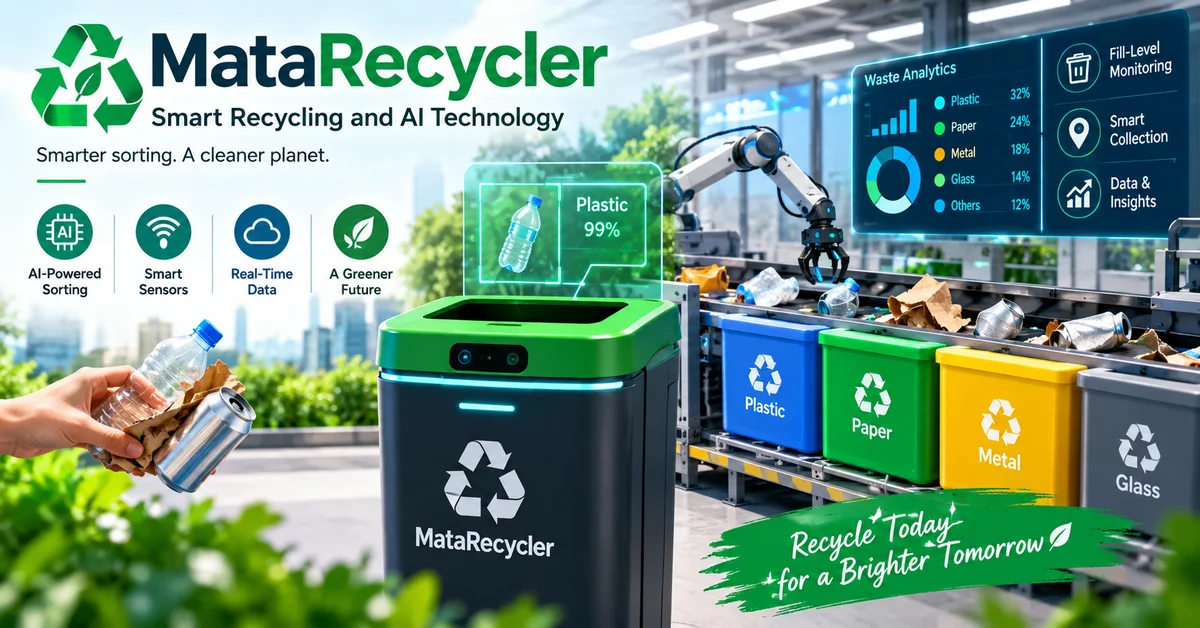
MataRecycler is an intelligent recycling system designed to improve waste classification and material sorting. Instead of relying entirely on people to identify where an item belongs, a smart recycling system can use cameras, sensors, software, and automated equipment to recognize waste and direct it toward an appropriate stream.
The broader principle behind MataRecycler recycling is well established: cleaner separation can make recycling operations more effective. Recycling facilities commonly sort materials, remove contaminants, and prepare recovered material for further processing. AI-based waste classification is now an active research area, with machine learning and deep learning being investigated for automated identification and sorting.
Traditional recycling depends heavily on correct disposal and effective collection. When unsuitable items enter a recycling stream, they may need to be removed later, increasing processing work and potentially reducing the quality of recovered materials. Local recycling rules also differ, so an item accepted in one program may not be accepted in another.
Smart waste management attempts to address part of this challenge through better information. A connected system can potentially recognize materials, monitor bins, record waste patterns, and help collection teams respond to actual demand. This supports a wider move toward sustainable waste management and a circular economy, where useful resources remain in productive use for longer.
Related: Mimshacks: Games, Roblox Guides & Gaming Tools
How Does MataRecycler Work?
AI-Based Waste Identification
The reported MataRecycler system begins with material identification. A camera or other sensor can inspect an object and collect information about its appearance or physical characteristics. Artificial intelligence can then compare those characteristics with patterns learned during training.
Machine learning and deep learning are particularly relevant here. Research into AI-based waste classification shows that computer models can be trained to distinguish different waste categories. Computer vision systems may examine shape, colour, texture, size, and other visible features to classify objects.
This does not mean an AI system will always recognize every object correctly. Real waste is messy, packaging changes frequently, and objects may be damaged, dirty, folded, or partially hidden. Research reviews also identify real-world variability, dataset imbalance, and standardization as important challenges for automated waste classification.
Sensors and Automated Sorting
After an item is classified, automation can help move it toward the appropriate collection area. Depending on the equipment, sorting can involve conveyors, mechanical devices, robotic systems, air-based separation, magnets, or other technologies.
This is where MataRecycler technology could connect identification with physical waste sorting. Instead of simply telling someone that an item belongs in a particular category, an automated recycling system can potentially make the physical separation itself.
The exact hardware associated with MataRecycler has not been publicly documented in enough detail to confirm one standardized configuration. Therefore, automated sorting should be understood as a reported application of the concept rather than a verified specification for every MataRecycler installation.
Technology Behind MataRecycler
Artificial Intelligence and Machine Learning
Artificial intelligence is central to descriptions of MataRecycler AI. The basic concept is that software learns patterns from examples and uses those patterns to classify new waste items.
A modern AI recycling system may use machine learning or deep learning models to recognize different categories of waste. Research published in the scientific literature shows growing interest in AI for waste classification, sorting, optimization, and resource recovery.
The strongest results in research environments do not automatically guarantee identical performance in real recycling facilities. Lighting conditions, dirty objects, unusual packaging, mixed materials, and different local waste streams can all affect performance. For this reason, practical testing matters as much as model accuracy.
Computer Vision and Smart Sensors
Computer vision recycling systems use cameras to gather visual information. Software can examine an object’s characteristics and estimate which category it belongs to. This technology is particularly useful when visual differences between materials can be detected reliably.
Smart sensors can provide additional information. Depending on the system, sensors may monitor weight, volume, fill level, movement, or other physical conditions. Combining multiple sources of information can potentially make waste classification and monitoring more useful than relying on a single camera.
Edge computing may also be useful in smart recycling because some processing can occur close to the device rather than sending every piece of information to a remote server. The exact role of edge computing in MataRecycler has not been independently confirmed, but it is a relevant technology for connected waste systems.
IoT and Waste Data Analytics
The Internet of Things can connect smart bins, sensors, sorting equipment, and management software. A connected waste bin could report its fill level, while a central dashboard could collect information from multiple locations.
Cloud computing can make this information accessible to authorized managers across a network. Waste analytics may then reveal which locations generate the most waste, which materials appear most often, and when collection demand increases.
Predictive analytics could eventually help organizations anticipate collection needs rather than simply responding after bins become full. These capabilities are part of the wider development of intelligent waste management, although they should not automatically be treated as confirmed features of MataRecycler.
What Materials Can MataRecycler Handle?
Plastic, Paper, and Cardboard
Plastic is one of the most important materials discussed in connection with smart recycling. Different plastics can have different properties and recycling pathways, making accurate identification valuable. PET and HDPE are examples of commonly recognized plastic categories.
Paper and cardboard are also major recycling materials. However, their condition matters. Wet, heavily soiled, or mixed-material paper products may not be suitable for every recycling program.
MataRecycler descriptions mention these common categories, but no definitive official compatibility list has been established. Local recycling infrastructure ultimately determines what can be accepted and processed.
Glass and Metals
Glass and metals can also be separated through automated recycling processes. Aluminium and steel are particularly valuable materials because they can be recovered and processed through established recycling pathways.
A smart material-sorting system can potentially help distinguish metals from other waste and direct them toward the correct processing stream. Glass may likewise be separated from plastic and metal packaging before further treatment.
Again, the ability to identify an item does not necessarily mean that a local facility can recycle it. Collection rules, processing equipment, contamination levels, and market conditions all influence what happens after sorting.
E-Waste and Composite Materials
Electronic waste is considerably more complicated. Electronics can contain multiple materials and may also include components requiring specialized handling. AI-assisted identification could support sorting, but e-waste should not be treated like ordinary household recyclables.
Composite packaging presents another challenge because one item can contain plastic, paper, foil, adhesives, or coatings. These combinations can be difficult for both people and automated systems to classify.
Therefore, claims that MataRecycler can handle every form of electronic, organic, or composite waste should be treated cautiously unless supported by a specific technical specification.
Key Features of MataRecycler
Smart Bins and Fill-Level Monitoring
The MataRecycler smart bin concept focuses on turning an ordinary container into a connected waste-management device. Sensors could monitor how full a bin is and send information to a central system.
Fill-level monitoring can support more responsive collection. Instead of treating every bin as equally urgent, operators can identify locations that require attention first. This approach can be especially useful across large campuses, commercial sites, or public spaces.
Automated Material Sorting
Automated recycling is another major concept associated with MataRecycler. AI can classify objects while mechanical or robotic equipment can help move them into appropriate streams.
Automation may reduce repetitive manual sorting and provide consistent processing. Research into AI and robotics demonstrates the potential of vision-guided systems for identifying and separating waste, although real-world performance depends heavily on equipment design and operating conditions.
Waste Tracking and Analytics
Waste tracking can turn everyday disposal into useful operational data. Organizations could potentially monitor quantities, categories, collection frequency, and contamination patterns.
For businesses and municipalities, these records may support sustainability planning and resource management. Analytics can reveal where improvements are needed and help managers make decisions based on actual waste patterns rather than assumptions.
How MataRecycler Can Reduce Recycling Contamination
Identifying Incorrect Materials
Recycling contamination occurs when unsuitable materials enter a recycling stream. For example, an item that a local program does not accept may be placed into a recycling bin because the user assumes it is recyclable.
MataRecycler AI recycling could potentially reduce this problem by identifying an item before it enters the wrong stream. AI-based detection and classification are increasingly studied for exactly this purpose.
Still, technology cannot eliminate contamination completely. Local recycling rules, human behaviour, packaging design, and the physical condition of waste all remain important factors.
Improving Recycling Stream Quality
Cleaner recycling streams can make downstream processing more manageable. The EPA notes that contamination can create additional sorting work and may contribute to equipment problems or disposal of unsuitable materials.
Better material identification therefore has practical value. If a system can reliably separate materials and contaminants, it may support improved resource recovery and recycling efficiency.
The key word is reliably. A claimed AI accuracy percentage should not be assumed to represent MataRecycler specifically unless it comes from a transparent, independently verifiable test.
MataRecycler for Homes, Businesses, and Schools
Household and Community Recycling
For households, smart recycling could simplify confusing disposal decisions. A digital assistant or smart bin could potentially provide sorting guidance, reminders, or information about local recycling rules.
Community recycling hubs could also benefit from connected monitoring. Operators could see which collection points need attention and identify patterns in local waste generation.
Some online descriptions associate MataRecycler with an app, but a specific official app has not been clearly established. This feature should therefore be treated as a reported possibility rather than a confirmed product specification.
Business and Institutional Waste Management
Businesses often produce large quantities of packaging and mixed waste. Retailers, offices, hotels, schools, universities, and other institutions could potentially use intelligent recycling systems to improve waste segregation and monitor disposal patterns.
Better waste tracking can also support sustainability reporting. However, using a smart recycling system does not automatically guarantee environmental compliance. Organizations still need to follow the laws and recycling requirements applicable to their location and industry.
MataRecycler and Smart Cities
Intelligent Waste Collection
Smart city waste management can use connected bins and data systems to improve public waste collection. If a bin reports that it is nearly full, a collection team can potentially prioritize it rather than following a completely fixed schedule.
This approach can be particularly useful when waste generation changes because of weekends, events, seasons, or population movement. Better information can help cities respond more efficiently.
Route Optimization and Data-Based Planning
Waste route optimization uses information about collection requirements to help plan vehicle journeys. If fewer unnecessary stops are made, organizations may potentially reduce fuel consumption, travel time, and operational costs.
Long-term waste analytics can also help cities decide where additional recycling infrastructure is needed. These benefits belong to the broader smart waste management field and should not be presented as measured MataRecycler results without verified case-study evidence.
Benefits and Limitations of MataRecycler
Potential Environmental and Operational Benefits
The biggest potential benefit of MataRecycler is better waste sorting. More accurate material identification could reduce contamination and support recovery of useful materials.
Smart collection can also improve operational efficiency. Fill-level monitoring, waste tracking, and data analytics may help organizations make better decisions about collection and resource allocation.
These ideas support wider sustainability goals. UNEP’s Global Waste Management Outlook emphasizes waste prevention, improved management, resource recovery, and circular economy approaches as important parts of addressing the global waste challenge.
Costs, Maintenance, and AI Limitations
Smart technology requires investment. Cameras, sensors, software, connectivity, automated equipment, and maintenance can all increase costs compared with conventional bins and manual processes.
AI also has limitations. Models need suitable training data and can struggle with unfamiliar objects, poor lighting, damaged packaging, contamination, and mixed materials. Equipment requires cleaning, calibration, software updates, and maintenance.
Privacy and cybersecurity should also be considered when connected devices use cameras or transmit data. Any real deployment should have clear information about data collection, access controls, security, and retention.
Is MataRecycler a Real Product or a Recycling Concept?
What Information Is Currently Available
MataRecycler is described online as an AI-powered recycling and waste-management system, but the available descriptions are not completely consistent. Some portray it as a physical smart recycling system involving sensors, cameras, automated sorting, and analytics, while another reported description presents an app-style recycling assistant.
At the same time, the underlying technologies are genuine. AI waste classification, computer vision, robotics, smart sensors, IoT connectivity, and automated sorting are all active areas of research and development.
The most responsible conclusion is therefore that MataRecycler should be treated as a reported smart-recycling system or concept unless stronger primary documentation establishes a specific commercial product and its specifications.
Pricing, Availability, and Ownership Questions
MataRecycler pricing has not been reliably established from the available information. There is no sufficiently clear public documentation confirming purchase prices, subscription plans, installation fees, or enterprise packages.
Availability is similarly unclear. Claims about international deployment should be checked against named customers, locations, official announcements, or independent case studies before being presented as confirmed.
Ownership and development information also remain limited. A trustworthy technology profile should ideally identify the organization responsible for the product, its technical documentation, support arrangements, privacy policies, and deployment history.
For readers researching MataRecycler, this evidence-first approach is valuable. It allows the exciting potential of smart recycling to be appreciated without confusing general industry capabilities with independently verified MataRecycler results.
Related: Daily Tens: Complete Guide to the Trivia Game
Frequently Asked Questions
What is MataRecycler?
MataRecycler is described online as a smart recycling and waste-management system associated with artificial intelligence, sensors, computer vision, automation, and data analytics. Its reported purpose is to improve sorting and reduce recycling contamination.
How does MataRecycler work?
The reported concept involves cameras or sensors examining waste, AI identifying material categories, and automated equipment directing items toward suitable recycling streams. Connected systems may also monitor bins and collect waste data.
What materials can MataRecycler identify?
Descriptions mention plastic, paper, cardboard, glass, aluminium, steel, e-waste, organic waste, and composite materials. However, a definitive official compatibility list has not been established.
Can MataRecycler reduce recycling contamination?
Potentially. AI-based material identification can help detect unsuitable items before they enter the wrong stream. Actual results would depend on the system, training data, equipment, local recycling rules, and operating conditions.
Is MataRecycler available as an app?
One online description associates MataRecycler with an app-based recycling assistant, but a clearly confirmed official app has not been established. Other descriptions focus mainly on physical smart bins and automated recycling.
How much does MataRecycler cost?
Reliable MataRecycler pricing has not been confirmed. Purchase, subscription, installation, and maintenance costs should not be assumed without official documentation.
Is MataRecycler used by cities and businesses?
Online descriptions suggest possible applications in businesses, schools, communities, and municipalities. However, specific deployments should be independently verified before being presented as confirmed case studies.
Summary
MataRecycler represents an interesting vision for the future of recycling: combine artificial intelligence, computer vision, smart sensors, automation, robotics, and waste analytics to make material recovery more efficient. These technologies are supported by a growing body of research, while global organizations continue to emphasize better waste management and circular economy approaches.
The most important point is accuracy. The smart-recycling technologies associated with MataRecycler are real, but specific claims about ownership, pricing, availability, deployments, and performance remain less certain. Readers should therefore distinguish established industry technology from claims specifically attributed to MataRecycler.
If developed and deployed effectively, intelligent waste systems could help households, businesses, schools, recycling facilities, and smart cities make better use of valuable materials. The strongest future for MataRecycler—or any similar recycling solution—will depend not only on advanced AI, but also on reliable infrastructure, transparent data, responsible maintenance, local recycling policies, and measurable real-world results.