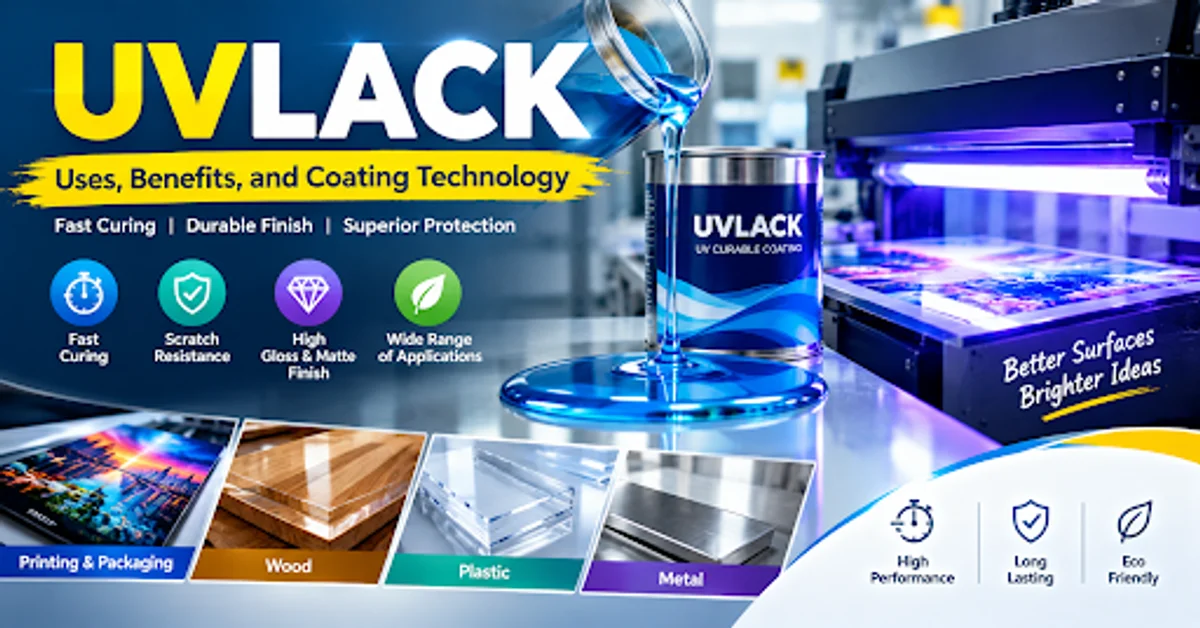
UVLACK is a protective coating, commonly known as UV lacquer, that hardens when exposed to ultraviolet (UV) light. It is made from resins, monomers, photoinitiators, and additives that work together to create a durable surface finish.
UVLACK is widely used in printing, packaging, woodworking, and industrial manufacturing. It can provide a glossy or matte appearance while improving surface protection, scratch resistance, and durability. One of its main advantages is its rapid curing process, which helps manufacturers save time and improve production efficiency.
The UVLACK curing process begins when a liquid coating is applied evenly to a prepared surface. A suitable UV curing lamp then exposes the coating to ultraviolet energy, activating light-sensitive ingredients that initiate a chemical reaction.
This reaction transforms the liquid coating into a hardened film, often within seconds under optimized industrial conditions. Unlike conventional varnish, which may dry through evaporation or chemical reactions over a longer period, UV lacquer can be ready for the next production step shortly after proper curing.
Related: MataRecycler: Smart Recycling and AI Technology
Key Ingredients Used in UVLACK
Resins, Monomers, and Additives
Resins provide the foundation of a UV coating. Acrylic resin is widely used because it can offer rapid curing, clarity, and good surface performance. Epoxy resin and polyurethane-based materials may also be used in particular formulations to achieve specific adhesion, flexibility, or chemical-resistance properties.
Monomers and oligomers help determine the coating’s viscosity, hardness, flexibility, and curing behavior. Additives can improve leveling, surface smoothness, slip, defoaming, and other properties. Pigments are included in colored coatings, although they can affect how deeply UV light penetrates the material.
The Role of Photoinitiators
A photoinitiator is a light-sensitive chemical that absorbs energy from an appropriate UV wavelength and generates reactive species. These species start the reactions that connect the coating’s chemical building blocks into a solid network.
The choice of photoinitiator affects curing speed, surface quality, and compatibility with the curing equipment. A formula designed for a traditional mercury lamp may not cure correctly under a UV LED system if its ingredients do not absorb the LED’s wavelength effectively. Correct formulation and equipment matching are therefore essential.
How Does the UVLACK Curing Process Work?
Understanding Polymerization and Crosslinking
Polymerization is the chemical process through which smaller molecules react to form larger molecular structures. In UV-curable coatings, this reaction helps convert the liquid formulation into a solid film.
Crosslinking creates connections between molecular chains, forming a network that gives the cured coating its characteristic properties. Depending on the formulation and curing conditions, this network can improve hardness, scratch resistance, and chemical resistance. However, the final performance depends on the chemistry used and whether the coating cures completely.
Factors That Affect Curing Speed
Several factors influence UVLACK curing speed, including lamp intensity, wavelength, exposure time, coating thickness, and production-line speed. The formulation also matters because photoinitiators, resins, and pigments respond differently to UV energy.
Clear, thin coatings may cure more easily than thick or heavily pigmented layers. Dark pigments can absorb or block some UV energy, making it difficult to cure the material beneath the surface. Manufacturers should follow the supplier’s curing recommendations and verify the result through appropriate testing rather than relying only on touch.
Main Applications of UVLACK
UVLACK in Printing and Packaging
The printing industry uses UV lacquer to enhance brochures, book covers, labels, business cards, and other printed products. A gloss finish can make colors appear more vibrant, while a matte finish creates a softer appearance. Spot UV coating can highlight selected design elements, helping logos, images, and text stand out.
The packaging industry also uses UVLACK on suitable cartons, labels, and decorative packaging. The coating can improve handling resistance and help maintain a polished appearance during distribution. However, food packaging requires particular care: the coating, curing process, and packaging design must comply with applicable requirements for the intended use.
UVLACK for Wood, Plastic, and Metal
UVLACK for wood is used on furniture panels, cabinets, flooring components, and decorative surfaces. It can provide an attractive finish and protect against everyday scuffs, depending on the product specification. In woodworking, rapid curing can help manufacturers move coated panels through production more efficiently.
UVLACK for plastic and metal requires formulations designed for the relevant substrate. Some plastics have low surface energy, which can make adhesion difficult, while metals may require cleaning, pretreatment, or a suitable primer. The coating should be tested on the actual material before full-scale production begins.
Benefits of Using UVLACK
Fast Curing and Improved Productivity
One of the biggest UVLACK benefits is its ability to cure rapidly under suitable conditions. Because the coating can harden in a short exposure, manufacturers may reduce waiting time between finishing and handling. This can support faster production schedules and reduce the space needed for drying areas.
UV curing can also improve manufacturing efficiency by delivering consistent results when coating application and lamp settings are controlled. However, actual productivity depends on the complete production line, including surface preparation, application, inspection, and curing capacity.
Surface Protection, Gloss, and Durability
A properly formulated and fully cured UVLACK protective coating can provide scratch resistance, abrasion resistance, and protection against certain chemicals. These qualities help preserve the appearance of suitable surfaces during normal handling and use.
UV lacquer is available in different finishes, including gloss, satin, and matte. The appropriate choice depends on the product’s appearance and performance requirements. No coating is completely damage-proof, so its resistance to impacts, cleaning products, moisture, and wear should be confirmed through relevant testing.
UVLACK vs. Traditional Varnish
Differences in Performance and Drying Time
The main difference between UVLACK and normal varnish is how each coating reaches its finished state. Traditional varnishes may dry as solvents or water evaporate, or harden through chemical reactions. UV lacquer uses light-triggered chemistry to cure the coating.
UV coatings can offer faster processing and strong surface performance, making them attractive for high-volume manufacturing. Traditional water-based, solvent-based, or two-component coatings may be more practical for complex shapes, on-site applications, or surfaces that cannot be exposed to suitable UV light.
Cost, Efficiency, and Environmental Considerations
UVLACK cost involves more than the price of the liquid coating. Manufacturers should consider the curing equipment, electricity consumption, maintenance, labor, production speed, rejected products, and the number of coats required.
Some UV formulations contain little or no volatile solvent, which can reduce solvent emissions compared with certain conventional products. However, this does not mean every UV coating is environmentally harmless. Ingredient hazards, energy use, waste management, and the complete manufacturing process must also be considered when comparing environmental performance.
UV Lamps vs. UV LED Curing Systems
Traditional Mercury-Based UV Lamps
Mercury vapor lamps have long been used in industrial UV curing. They emit a broad range of ultraviolet wavelengths, which can work with many established coating formulations. Their performance makes them suitable for various printing and industrial finishing operations.
However, traditional systems can generate considerable heat and may require cooling, lamp maintenance, and warm-up time. Mercury-containing equipment also needs appropriate handling and disposal procedures. Facilities should follow manufacturer instructions and applicable environmental and workplace regulations.
Advantages and Limitations of UV LED Technology
UV LED curing systems produce UV energy within a narrower wavelength range. They generally switch on and off quickly and can reduce unwanted heat exposure compared with some traditional systems. These characteristics make them useful for heat-sensitive materials, including certain plastic films.
Nevertheless, UV LED curing is not automatically compatible with every UVLACK formula. The coating’s photoinitiator must respond to the LED’s output, and the energy delivered to the surface must be sufficient. Before changing systems, manufacturers should confirm wavelength compatibility and conduct curing trials.
Common UVLACK Problems and Solutions
Poor Curing, Sticky Surfaces, and Coating Defects
Poor curing is a common problem when the coating receives insufficient UV energy. A surface may feel dry while the material underneath remains insufficiently cured. Possible causes include excessive coating thickness, incorrect lamp settings, high production speed, or incompatibility between the coating and light source.
A sticky surface can also occur when oxygen interferes with surface curing in certain formulations. Corrective measures may include adjusting the curing conditions, using a compatible formulation, or applying an appropriate oxygen-control system. Any changes should follow supplier guidance and be verified through suitable tests.
Surface Preparation and Adhesion Issues
Dust, oil, moisture, and incompatible surface treatments can prevent UVLACK from bonding properly. This is particularly important when coating plastic or metal, where surface characteristics can vary considerably. Even an effective curing system cannot compensate for poor preparation.
The solution begins with cleaning the substrate using a compatible method and allowing it to reach the required condition before coating. Sanding, priming, or specialized surface treatment may be necessary for some materials. Adhesion testing on sample pieces helps identify problems before production begins.
UVLACK Safety, Care, and Maintenance
Safe Handling and Workplace Precautions
Uncured UV coatings should be treated as industrial chemical products. Certain resins and monomers can irritate or sensitize the skin, while splashes may harm the eyes. Workers should consult the product’s Safety Data Sheet (SDS) to understand its hazards, handling requirements, and emergency procedures.
Occupational safety measures may include suitable Personal Protective Equipment (PPE), effective ventilation, protective clothing, and procedures for cleaning spills. UV lamps must be shielded appropriately, and safety guards and interlocks should remain functional. Direct exposure to UV radiation can damage skin and eyes, even though UV radiation is non-ionizing.
Cleaning and Maintaining UV-Coated Surfaces
UVLACK maintenance is generally straightforward when the coating has been selected and cured correctly. Regular cleaning with a soft cloth and a cleaner approved for the finished surface can help maintain its appearance.
Avoid abrasive pads, harsh chemicals, and cleaning methods that may damage the coating. If the surface develops deep scratches or loses adhesion, repair options depend on the coating type and substrate. A compatible refinishing process may be necessary to restore the finish.
How to Choose the Right UVLACK
Selecting a Coating for Different Materials
Start by identifying the substrate, whether it is wood, paper, plastic, or metal. Each material has different requirements for adhesion, flexibility, appearance, and resistance. A coating suitable for a flat wooden panel may not perform well on a flexible plastic film or a complex molded component.
Next, define the desired finish and performance requirements. Consider gloss level, scratch resistance, chemical exposure, coating thickness, and expected service conditions. Sample testing can reveal whether the selected UVLACK meets these needs before the coating is used at scale.
Matching Coating Formulas with Curing Equipment
Check that the UVLACK formulation matches the available curing equipment. Important factors include the lamp type, wavelength, intensity, distance from the surface, exposure time, and production speed. These variables should be considered together rather than adjusted without a clear testing plan.
Ask the supplier for the Technical Data Sheet (TDS), Safety Data Sheet (SDS), and recommended curing conditions. The TDS provides technical information about application and performance, while the SDS explains chemical hazards and safe handling. Comparing suppliers on documented performance, consistency, support, and total operating cost is more useful than choosing solely by price.
Related: Rolerek: Sustainable Smart Home Technology
Frequently Asked Questions
What is UVLACK used for?
UVLACK is used to protect and improve the appearance of suitable surfaces, including printed paper, packaging, wood products, plastic components, and selected metal surfaces. Its exact uses depend on the coating formulation.
Is UVLACK better than normal varnish?
UVLACK can be better for fast, high-volume production because it cures quickly under suitable UV light. Traditional varnish may be more suitable for certain complex shapes, field applications, or surfaces that cannot receive UV exposure.
Does UVLACK protect against scratches?
Many UV coatings provide scratch and abrasion resistance, but the level of protection depends on the formulation, film thickness, curing quality, and type of contact. No coating is completely scratch-proof.
Is UVLACK safe to use?
UVLACK can be used safely when the product-specific handling instructions are followed. Uncured materials may present chemical hazards, and UV lamps can harm exposed skin and eyes. Proper PPE, ventilation, shielding, and training are important.
How long does UVLACK take to cure?
Some UVLACK coatings cure in seconds under suitable industrial conditions. Actual curing time varies according to the formula, lamp wavelength and intensity, coating thickness, substrate, and production speed. Follow the manufacturer’s specifications and verify complete curing before use.
Summary
UVLACK is a valuable finishing option for manufacturers who need rapid curing, attractive surfaces, and reliable protection. Its applications span printing, packaging, woodworking, plastics, and other industrial manufacturing processes. When the coating and equipment are correctly matched, it can improve production flow and help deliver consistent finishes.
However, UVLACK is not the ideal solution for every product. Equipment investment, curing limitations, surface preparation, and chemical safety all require attention. The best choice depends on the substrate, intended use, performance standards, and total cost of production.
UV curing technology continues to develop through improved LED systems, more efficient formulations, and coatings designed for specialized materials. Water-based UV coatings are another option: water helps the coating flow and is removed during processing before UV curing completes the film formation.
These developments may expand the range of applications for UVLACK while supporting more efficient manufacturing. The key remains careful product selection, controlled application, appropriate safety measures, and verified curing performance.


[…] Related: UVLACK: Uses, Benefits, and Coating Technology […]