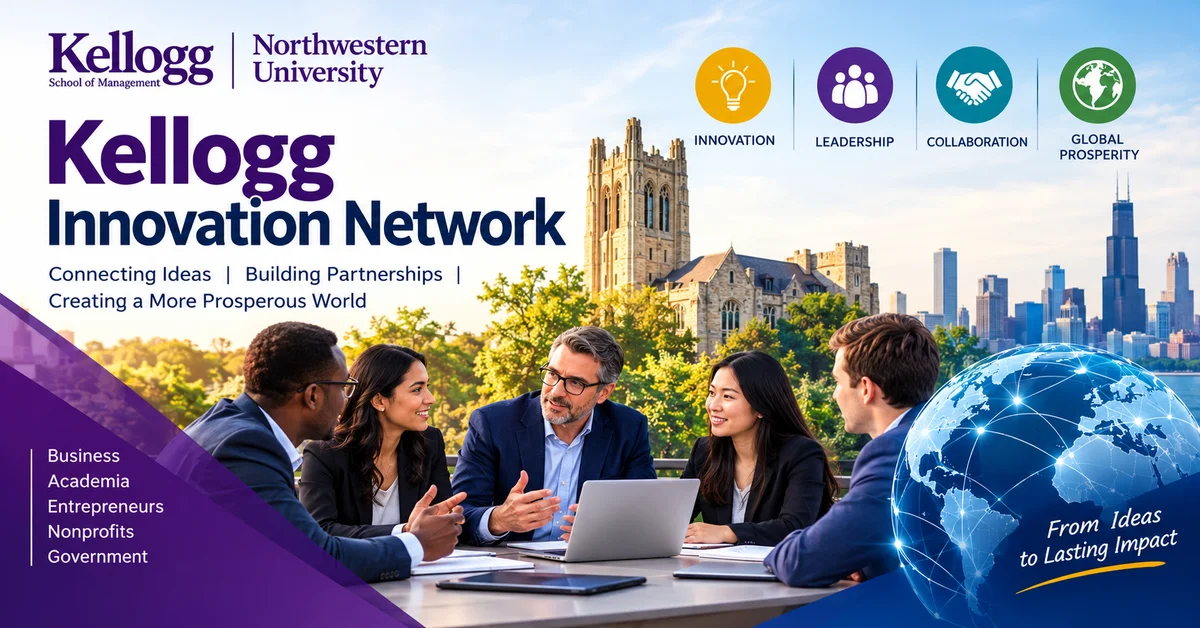
The Kellogg Innovation Network was created in association with the Kellogg School of Management at Northwestern University. It brought together experienced professionals and thinkers to discuss innovation, business strategy, leadership, and global prosperity.
Rather than concentrating only on new products or technologies, KIN explored innovation as a broader process of creating value. Its discussions connected corporate decision-making with entrepreneurship, social progress, and opportunities for economic development. This approach helped participants consider how ideas from one industry could inspire solutions in another.
The Kellogg Innovation Network mission centered on encouraging innovation-led growth and finding collaborative responses to important global challenges. It sought to create a setting where leaders could exchange knowledge, challenge conventional thinking, and explore opportunities that might be difficult to develop independently.
Another important goal was connecting discussion with action. KIN’s historical activities included initiatives and student competitions that supported practical ideas for prosperity. Its approach encouraged participants to consider not only whether an idea was original, but also whether it could deliver meaningful benefits to businesses and communities.
Related: Escapamento RD: Complete Guide to Yamaha RD Exhausts
History of the Kellogg Innovation Network
Founding and Early Development of KIN
The Kellogg Innovation Network history begins in 2003, when Kellogg faculty members Robert C. Wolcott and Mohanbir Sawhney helped establish the initiative alongside corporate innovation leaders. Their work connected academic research with the real challenges organizations faced when developing new ideas and strategies.
The founding concept reflected a growing recognition that innovation requires more than technical expertise. Businesses also need strong leadership, customer understanding, collaboration, and the ability to adapt to changing markets. KIN created opportunities for senior executives and academic experts to share their experiences and explore these issues together.
Key Milestones in Its Growth
An important milestone came in 2009, when KIN held its first Global Summit. The event, themed around building global prosperity through innovation and action, brought delegates from more than 20 countries and six continents together. Participants included corporate executives, academics, government leaders, and nonprofit representatives.
Subsequent summits continued this emphasis on turning ideas into practical initiatives. The KIN Prize, for example, supported student teams developing action plans related to challenges such as access to healthcare, affordable food, clean energy, and waste reduction. These historical activities illustrate how the network connected business innovation with wider social needs.
Mission and Vision of KIN
Promoting Innovation and Global Prosperity
The Kellogg Innovation Network’s purpose extended beyond improving company performance. It encouraged leaders to explore how innovation could support global prosperity, create economic opportunities, and address challenges affecting people and communities. This perspective connected business success with the broader responsibility to create lasting value.
The network’s historical summits encouraged participants to think about issues such as entrepreneurship, education, public health, and economic development. By discussing these topics across professional boundaries, participants could discover new ways to combine commercial opportunities with social benefits. Its central message was that innovation becomes more meaningful when it contributes to progress beyond an individual organization.
Building a Collaborative Innovation Ecosystem
A global innovation ecosystem depends on relationships among businesses, universities, governments, entrepreneurs, and nonprofit organizations. Each group contributes different knowledge, resources, and perspectives. KIN encouraged these groups to communicate and explore shared opportunities rather than working in isolation.
For example, a company developing a new healthcare service may understand technology and customer needs, while academic researchers can contribute evidence and government representatives can explain policy considerations. Collaboration can help these groups identify practical solutions and recognize potential challenges earlier.
KIN’s approach highlighted the importance of trust, open communication, and shared objectives. These principles remain valuable for organizations seeking innovation-driven business growth and sustainable prosperity.
Key Activities of the Kellogg Innovation Network
KIN Global Summit and Leadership Discussions
The KIN Global Summit was one of the network’s best-known activities. Introduced in 2009, it brought together leaders from different countries and sectors to discuss innovation and global prosperity. The events included presentations, discussions, and opportunities to explore practical responses to major challenges.
The summit’s value came from the diversity of its participants. Global business executives could exchange ideas with academic researchers, nonprofit founders, public officials, and emerging entrepreneurs. Such conversations encouraged people to reconsider familiar problems and discover perspectives outside their usual professional environments.
The historical KIN Global Summit also demonstrated that innovation discussions could produce concrete initiatives. However, attending an event or sharing an idea does not automatically guarantee success. Real impact depends on follow-through, resources, and effective implementation.
Networking, Knowledge Sharing, and Partnerships
Networking was another important element of Kellogg Innovation Network events. Participants could build professional relationships, exchange experiences, and identify potential partners for future projects. These connections could help organizations learn from each other’s successes and mistakes.
Knowledge sharing also supported better decision-making. A business leader facing a difficult innovation challenge might benefit from research, industry experience, or insights from an entrepreneur working in a different market. Bringing these perspectives together can strengthen problem-solving strategies and encourage more informed decisions.
KIN’s historical activities emphasized the connection between conversation and collaboration. Its approach illustrates how executive networking can become more valuable when relationships lead to shared learning, strategic partnerships, and practical action.
Role of Kellogg School of Management
Connection with Northwestern University
The Kellogg School of Management is part of Northwestern University, a private research university in Illinois, United States. Kellogg is known for business education, management research, leadership development, and its engagement with industry. This academic environment helped provide a foundation for KIN’s early development.
The connection between KIN and Kellogg brought academic thinking into conversations about real business challenges. Faculty members and corporate leaders could exchange ideas about innovation management, strategic leadership, and business growth while considering their practical implications.
An important distinction is that KIN’s original institutional connection should not be confused with its present organizational status. Robert C. Wolcott’s current Kellogg faculty profile describes KIN as having become an independent organization known as The World Innovation Network (TWIN). Readers researching the initiative today should therefore distinguish its historical identity from its subsequent development.
Academic Research and Business Innovation
Academic research can help businesses understand changing markets, emerging technologies, and customer behavior. The Kellogg School of Management’s Center for Research in Technology & Innovation, founded in 2001, focuses on questions involving innovation, technology, organizational transformation, and business growth.
Mohanbir Sawhney, one of KIN’s co-founders, has contributed to research and teaching in business innovation, technology, and marketing. Robert C. Wolcott has focused on corporate innovation and entrepreneurship, including how established companies develop new ventures. Their work reflects the value of connecting academic knowledge with organizational practice.
This relationship between research and industry helps explain why innovation networks can be useful. Academic insight can clarify a problem, while business experience can reveal practical limitations. When combined thoughtfully, both perspectives can support stronger business strategy development.
Who Participates in the Kellogg Innovation Network?
Business Leaders, Entrepreneurs, and Executives
KIN’s historical participants included corporate innovation leaders, global business executives, entrepreneurs, and senior professionals. These individuals brought experience in managing organizations, developing products, entering markets, and responding to changing customer needs.
Entrepreneurship was particularly relevant because entrepreneurs often work with limited resources while testing new ideas. Established companies, meanwhile, may have more resources but face organizational barriers to change. Bringing these groups together created opportunities to exchange lessons about experimentation, leadership, and growth.
For corporate participants, the network offered a way to explore challenges beyond their immediate industries. For entrepreneurs, conversations with experienced executives could provide broader perspectives on scaling ideas and building partnerships. The benefits depended on each participant’s goals and willingness to turn new knowledge into action.
Researchers, Government Representatives, and Nonprofits
KIN also brought together academic researchers, government representatives, and nonprofit organizations. These participants helped broaden discussions beyond commercial performance to include public policy, community needs, education, and social innovation. Historical summit reports document participation from all these sectors.
Academic researchers could contribute evidence and analytical frameworks. Government representatives could explain public priorities and policy considerations, while nonprofit organizations could highlight challenges affecting communities. These perspectives helped business participants consider the wider effects of their decisions.
This cross-sector approach is especially valuable when addressing complex problems. Improving access to healthcare, for instance, may require technology, financing, public policy, and community trust. No single organization necessarily has every resource required, making cooperation an important part of effective problem-solving.
Benefits of the Kellogg Innovation Network
Opportunities for Collaboration and Networking
One potential benefit of KIN’s model was access to people with different professional experiences. A diverse network can help participants discover partners, compare approaches, and identify opportunities that might otherwise remain unnoticed.
Cross-industry collaboration can also challenge assumptions. A strategy used successfully in education might inspire a new approach to employee training, while developments in digital technology might improve services in healthcare or public administration. These connections can encourage fresh thinking without requiring every organization to start from scratch.
However, networking alone does not guarantee business success. The practical value of professional relationships depends on trust, relevant expertise, clear goals, and continued cooperation. KIN’s model is best understood as a way to create opportunities for collaboration rather than a promise of specific results.
Supporting Strategic Growth and New Ideas
Innovation can help organizations identify new markets, improve products, and respond to changing customer expectations. Through knowledge sharing and strategic partnerships, innovation networks can expose participants to approaches they might not have considered independently.
KIN’s historical student competitions provided one example of this principle. Teams developed action plans addressing issues such as affordable food, healthcare access, and clean energy, while participants helped direct financial support toward selected projects. These activities connected entrepreneurship and innovation with practical attempts to create social and economic value.
For businesses, the broader lesson is to evaluate ideas through both strategic and practical lenses. A promising concept needs a clear problem to solve, a viable implementation plan, suitable resources, and a way to measure progress.
KIN’s Approach to Global Innovation
Cross-Industry Collaboration and Problem-Solving
Cross-industry collaboration allows organizations to combine different capabilities. Technology companies may understand digital systems, manufacturers may bring operational expertise, and nonprofit organizations may have deep knowledge of community needs. Together, these participants can develop approaches that would be difficult to create independently.
KIN encouraged dialogue among people with different backgrounds and priorities. Such conversations can help participants identify overlooked assumptions, compare possible solutions, and build shared understanding. This is especially useful when challenges involve several industries or countries.
Effective collaboration still requires careful planning. Participants need clear responsibilities, realistic expectations, and a shared understanding of what success means. When these elements are present, a global business ecosystem can support better experimentation and more informed decisions.
Innovation for Sustainable Economic Growth
Sustainable economic growth involves creating opportunities that can continue over time while considering environmental and social effects. Innovation can contribute through improved resource use, new services, more efficient operations, and solutions that address unmet needs.
KIN’s focus on global prosperity reflected this broader perspective. Its historical initiatives included ideas related to healthcare, food access, waste reduction, and clean energy. These examples show how innovation can connect commercial activity with wider development goals.
For organizations applying these principles today, long-term value creation requires more than an exciting idea. Leaders should consider financial viability, environmental consequences, community needs, and the ability to measure results. This balanced approach can help ensure that innovation supports lasting progress rather than short-term gains alone.
Impact and Challenges of the Kellogg Innovation Network
Influence on Business Innovation and Leadership
KIN’s historical activities created opportunities for participants to exchange ideas, explore partnerships, and support promising initiatives. Reports from its summits describe projects that emerged from discussions, student competitions, and cooperation among delegates. These examples demonstrate activity and engagement, although they do not establish that every initiative achieved long-term success.
The network also highlighted the importance of strategic leadership. Successful innovation often requires leaders to challenge established practices, listen to different perspectives, support experimentation, and allocate resources to promising opportunities. These skills remain relevant to organizations navigating technological change and competitive pressure.
Measuring Results and Addressing Modern Challenges
Measuring innovation impact is difficult because results may appear over months or years. A successful collaboration might produce a new service, improve an existing process, or influence a policy. Other initiatives may generate useful knowledge without leading to an immediate commercial outcome.
Organizations evaluating innovation programs should consider indicators such as ideas implemented, partnerships sustained, customer outcomes, operational improvements, and measurable social benefits. They should also distinguish between activities completed and outcomes actually achieved.
Another challenge is maintaining cooperation across sectors with different incentives. Businesses may prioritize commercial returns, while public institutions and nonprofits may focus on wider social outcomes. Clear objectives, transparent decision-making, and accountability can help align these priorities.
Future of the Kellogg Innovation Network
Emerging Trends in Global Innovation
Innovation continues to evolve through artificial intelligence, digital transformation, entrepreneurship, and new approaches to sustainable development. These changes create opportunities for organizations to improve services and develop new solutions, but they also raise questions about responsible implementation, privacy, skills, and accountability.
The collaborative principles associated with KIN remain relevant in this environment. Businesses can benefit from academic research, entrepreneurs can learn from established organizations, and public institutions can contribute perspectives on broader social needs. Cooperation can help these groups understand emerging challenges and evaluate possible responses.
It is important, however, to distinguish general future trends from confirmed KIN programs. The existence of new technologies does not establish that a particular initiative currently operates under the Kellogg Innovation Network name.
Opportunities for Future Collaboration
Robert C. Wolcott’s current Kellogg faculty profile states that the original KIN developed into an independent organization known as The World Innovation Network, or TWIN. Its annual summit is identified as TWIN Global. This is important context for readers seeking current information about the network’s continuing activities.
The wider model of collaboration can continue to inform innovation initiatives in business, education, and public service. Organizations can apply its principles by bringing together different perspectives, setting shared priorities, testing solutions, and measuring outcomes.
For readers interested in participating in related initiatives, the most reliable approach is to consult official institutional and organizational sources for current programs, events, eligibility, and contact information. Historical KIN names and activities should not automatically be treated as current offerings.
Related: LBYTHJ: SEO Benefits and Future Possibilities
Frequently Asked Questions
What is the Kellogg Innovation Network?
The Kellogg Innovation Network (KIN) was an initiative established in 2003 to connect business leaders, academic researchers, entrepreneurs, nonprofit organizations, and government representatives to explore innovation and global prosperity.
Who founded the Kellogg Innovation Network?
KIN was founded in 2003 with the involvement of Robert C. Wolcott, Mohanbir Sawhney, and corporate innovation leaders associated with the Kellogg community.
What was the purpose of the KIN Global Summit?
The KIN Global Summit brought together participants from different sectors and countries to discuss global challenges, exchange knowledge, develop partnerships, and explore practical innovation initiatives.
What role did Northwestern University play in KIN?
Northwestern University’s Kellogg School of Management provided the academic setting associated with KIN’s creation and early development. Kellogg faculty and business leaders helped connect research, management practice, and innovation.
Is the Kellogg Innovation Network still operating under the same name?
Robert C. Wolcott’s current Kellogg faculty profile describes KIN as an independent organization now known as The World Innovation Network (TWIN). Readers should check official sources for current activities and event information.
Summary
The Kellogg Innovation Network was established in 2003 to connect business leaders, academics, entrepreneurs, nonprofit organizations, and government representatives around innovation and global prosperity. Its best-known activities included the KIN Global Summit and initiatives designed to connect new ideas with practical action.
Its history demonstrates the value of knowledge sharing, strategic partnerships, and cross-industry collaboration. It also highlights the importance of distinguishing ambitious goals from measurable outcomes when evaluating innovation programs.
The lasting significance of the Kellogg Innovation Network lies in its emphasis on cooperation. It encouraged participants to look beyond their own organizations and consider how shared knowledge could help address broader challenges.
Although the original network has evolved into an independent organization known as TWIN, the underlying principles remain relevant: innovation benefits from diverse perspectives, responsible leadership, practical action, and a commitment to creating lasting value.