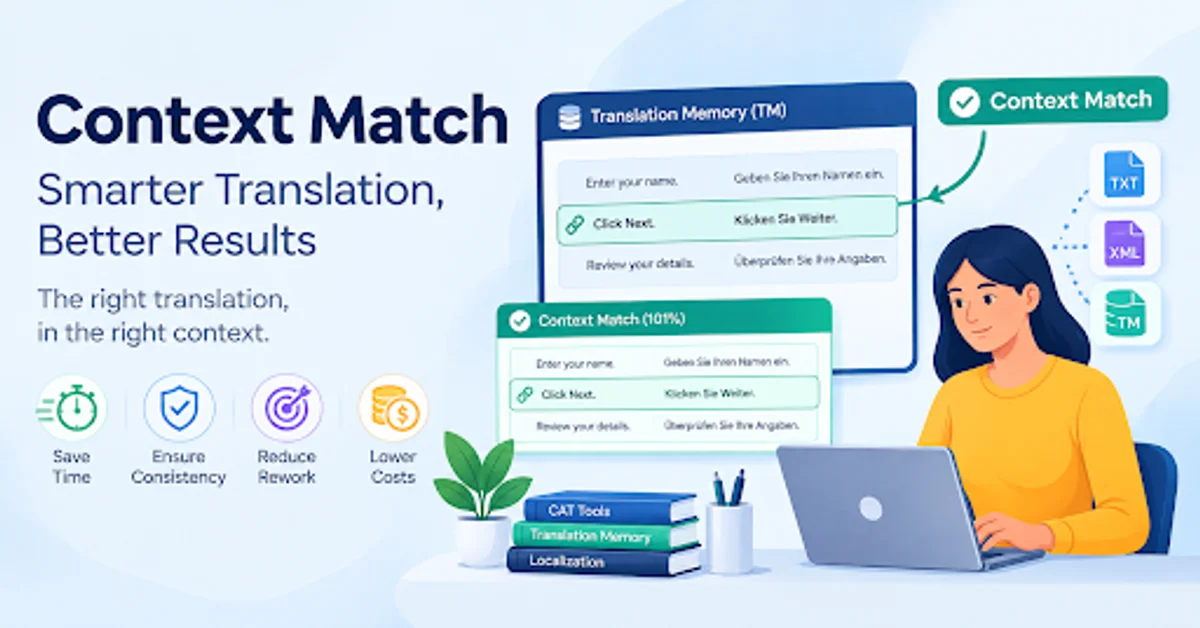
Context Match occurs when a CAT tool finds an identical source segment in its Translation Memory (TM) and confirms that the required contextual information also matches. The tool can then suggest the previously stored translation for reuse.
A Translation Memory stores pairs of source and target segments. For example, an English sentence may be saved alongside its approved German, French, or Spanish translation. When the same sentence appears again in a matching context, the translator can reuse the existing translation instead of translating it from scratch.
The term Context Match is particularly relevant when short phrases have different meanings depending on where they appear. A button labelled “Close” may instruct someone to shut a window, while the same word in a sentence may describe something nearby. Context helps translators distinguish between these meanings.
Computer-Assisted Translation software compares new source segments with previously translated entries. If the source text matches exactly and the required contextual conditions are satisfied, the software may identify the result as a Context Match.
Some CAT tools and workflows call this a 101% match. The extra percentage is a category label, not a measurement of translation accuracy. The exact rules vary by software and may involve neighboring segments, document structure, unique IDs, or other metadata.
For example, if an application repeatedly uses “Click Next” in the same installation process, a Context Match can help reuse the approved translation. This makes translation workflows more efficient while allowing professionals to focus on new content and difficult language choices.
Related: Lucipara: Facts About the Small Angle Shades Moth
How Does Context Matching Work?
The Role of Translation Memory (TM)
Translation Memory is the foundation of traditional Context Matching. It stores previously translated segments so that translators can reuse suitable content across documents, projects, and software releases. Each entry generally connects a source segment with its corresponding target translation.
When a new document enters a CAT tool, the software searches the Translation Memory database for matching or similar content. Depending on the wording and available contextual information, it may return an exact match, a fuzzy match, or a Context Match.
A well-maintained TM improves translation reuse and consistency. However, the quality of a suggested translation depends on the quality of the original entry. If the database contains outdated terminology or an incorrect translation, the same problem may appear in future projects.
How Context, Segment IDs, and Metadata Help
Context Matching does not always depend on the sentence before or after a segment. Some systems use document structure, segment position, context keys, unique IDs, or other contextual metadata to determine where a piece of text belongs.
Imagine two software buttons labelled “Save.” One appears in account settings, while the other appears in a document editor. Although the wording is identical, their purposes may differ. Context metadata can help the CAT tool distinguish between these situations and suggest the appropriate translation.
Structured formats such as XML may preserve IDs and other information that supports matching. If a file conversion removes this information or a software update changes the document structure, the CAT tool may no longer recognize the original context. Maintaining stable structures can therefore improve Context Match results.
Context Match vs. 100% Match vs. Fuzzy Match
Key Differences Between Translation Match Types
Understanding Context Match vs. 100% match vs. fuzzy match helps translators determine how much checking a suggested translation may require. Each match type supports translation memory matching, but the evidence supporting reuse differs.
A Context Match generally provides stronger evidence of suitability than an ordinary 100% match because the software has checked additional contextual information. However, a Context Match is not automatically more accurate if the stored translation contains an error.
Examples of Exact, Context, and Fuzzy Matches
Suppose a Translation Memory contains the sentence “Your order will arrive in 3 days.” If a new document contains the identical sentence, the CAT tool may return a 100% match. If the relevant contextual information also matches, the segment may qualify as a Context Match.
Now imagine the new sentence reads, “Your order will arrive in 5 days.” Because the number has changed, the tool may return a fuzzy match. The translator can reuse the sentence structure but must verify the updated delivery information.
These Context Match examples demonstrate why the distinction matters. An exact match identifies identical wording, a Context Match adds evidence about where the text belongs, and a fuzzy match provides a useful starting point when the source text has changed.
Benefits of Context Match in Translation
Improving Translation Speed and Consistency
One of the main benefits of Context Matching is faster translation. Professional translators frequently encounter repeated instructions, interface labels, product descriptions, and standard messages. Reusing suitable translations reduces repetitive work and helps teams complete large projects more efficiently.
Context Match also supports translation consistency. When the same instruction appears across several pages, applications, or manuals, reusing an approved translation helps maintain a unified language experience. This is particularly valuable when multiple translators collaborate on a project.
Another advantage is improved workflow management. Translation teams can identify repeated content and focus their attention on new or complicated segments. Nevertheless, consistency depends on maintaining an accurate Translation Memory and updating terminology when business requirements change.
Reducing Repeated Work and Translation Costs
Translation projects often contain a mixture of new material and previously translated content. Context Matching helps identify suitable entries, making it easier to estimate the amount of new work and allocate resources efficiently.
Context Match translation pricing may reflect these productivity gains. Some agencies apply different rates to new words, fuzzy matches, 100% matches, and Context Matches. A Context Match may receive a larger discount under a particular pricing model, but there is no universal pricing rule.
Clients should check their provider’s match categories, review requirements, and pricing policy before approving a quotation. A Context Match does not automatically mean that the translation is free, because quality assurance and project-specific checks may still be required.
Where Are Context Matches Used?
Software, Website, and App Localization
Context Match in localization is particularly useful for software interfaces, websites, and mobile applications. These products frequently reuse short strings such as “Sign in,” “Continue,” “Settings,” and “Save changes.” Reusing approved translations helps maintain consistency across pages and software releases.
For example, an online store may use “Continue” during account registration and checkout. If the source text and relevant Context Match an existing entry, the tool can suggest the previously approved translation. This is valuable because short interface strings often provide little information about their intended meaning.
Localization teams can improve these results by preserving stable IDs, maintaining consistent source wording, and keeping structured files organized. When the function of an interface element changes, however, translators should confirm that the old translation still fits the new experience.
Technical Manuals and Business Documents
Technical manuals, business reports, product guides, and standard operating procedures often contain repeated instructions. Context Matching can help identify reusable content when a new edition of a document is prepared.
For example, a manufacturer updating a product manual may retain existing operating instructions while introducing new specifications. Reusing suitable translations reduces duplication and helps maintain consistent technical terminology across versions.
Important content still requires appropriate review. Legal conditions, medical information, financial instructions, and safety warnings may contain small changes that significantly affect their meaning. Even a strong Context Match should not replace careful verification when accuracy is critical.
Context Match in Popular CAT Tools
Context Matching in Trados Studio and memoQ
SDL Trados Studio and memoQ are established CAT tools that support Translation Memory-based translation workflows. They help translators identify reusable segments, manage terminology, and reduce repeated work. Their specific matching features, labels, and configuration options may differ.
In SDL Trados Studio, translators can work with Translation Memory suggestions and matching categories. memoQ also supports Translation Memory matching and context-related functionality. The precise conditions for a Context Match depend on the software version, settings, and project configuration.
Translators should consult the relevant documentation before assuming that the same match label has identical behavior in both applications. Understanding the tool’s rules helps teams establish appropriate review procedures and use stored translations more effectively.
Understanding ICE, 101%, and PerfectMatch
An In-Context Exact (ICE) Match and a 101% Match are terms associated with exact source matches that also satisfy additional contextual requirements. These labels generally indicate that the software has verified more than the source wording alone.
PerfectMatch is a related but distinct term used in translation workflows, particularly in Trados terminology. It can involve comparing new content with an earlier translated bilingual document to identify content that can be reused under the tool’s specific rules. It should not automatically be treated as identical to every Context Match or ICE match.
Phrase is another translation technology platform that supports Translation Memory-based workflows. Since features and terminology can change, users should check current product documentation rather than assume that SDL Trados Studio, memoQ, and Phrase apply identical matching rules.
Limitations and Risks of Context Matching
Outdated Translations and Context Errors
Although Context Matching can improve efficiency, its reliability depends on the stored translation and the contextual information available. An old entry may contain incorrect terminology, an outdated product name, a spelling error, or a measurement that no longer applies.
Context can also be incomplete. Two segments may appear in the same structural position but serve different purposes in a newer version of a product. If the software cannot detect that change, it may suggest an unsuitable translation.
To reduce these risks, teams should review outdated entries, remove conflicting translations, and update approved terminology. Regular Translation Memory maintenance makes Context Match suggestions more useful and dependable.
Why Human Review Still Matters
Translation Quality Assurance (QA) includes checking terminology, numbers, formatting, missing content, and linguistic accuracy. Context Matching supports this process, but it does not replace human judgment.
Human translation review is especially important for high-impact content, including legal agreements, health information, financial instructions, and safety warnings. A professional reviewer can evaluate the wider meaning, audience, tone, and purpose of a segment.
The best approach is to use match categories to prioritize work rather than treating them as automatic proof of quality. Translators can spend less time on reliable repeated content and more time checking changed or sensitive material.
Best Practices for Better Context Matches
Maintaining Translation Memory and Terminology
A strong Translation Memory starts with accurate, approved translations. Teams should correct mistakes, remove obsolete entries, and resolve conflicting suggestions before they spread across future projects.
Terminology management is equally important. A termbase stores preferred terms and their approved translations, while a Translation Memory stores larger segments, such as sentences and instructions. For example, a software company can store the approved translation of a product feature in its termbase and reuse complete interface messages through its TM.
Using both resources improves consistency across large projects. Regular maintenance also helps translators avoid outdated terminology and choose appropriate translations when multiple similar entries are available.
Using Consistent Source Text, IDs, and Metadata
Consistent source writing can improve translation memory matching. If a company describes the same action in several different ways, the CAT tool may treat the strings as separate entries even when their meaning is similar.
Stable context keys, IDs, and document structure can also help. Teams should preserve relevant metadata when updating XML files, content management systems, or application resources. Consistent structures make it easier for CAT tools to recognize recurring content and its intended function.
Organizations should establish clear rules for pre-translation, review, and segment locking. Reliable matches may require fewer checks, while changed or high-risk content should receive closer attention.
Context Match and AI Translation Technology
Traditional Context Matching vs. Semantic Matching
Traditional Context Matching generally relies on stored Translation Memory entries and defined rules for comparing source text and contextual information. It can identify repeated content without requiring an AI model to interpret the complete meaning of each sentence.
Semantic matching takes a different approach by identifying text with similar meaning, even when the wording differs. For example, “Your payment was received” and “We have received your payment” communicate similar ideas but are not identical source segments.
Natural Language Processing (NLP) can help systems analyze language patterns and relationships. Semantic matching may suggest useful alternatives that traditional exact matching does not identify. However, its results still need to be checked for accuracy and suitability.
How AI Can Support Translation Workflows
Machine Translation automatically generates translations, while AI-assisted tools may suggest alternatives, identify terminology, or compare semantically similar segments. These technologies can complement Translation Memory when content is new or does not produce an exact Context Match.
For example, an AI-enabled localization workflow might suggest a similar translation when no suitable existing entry is available. A translator can then compare the suggestion with the source, approved terminology, and intended audience before accepting it.
AI should remain a support tool rather than a guarantee of accuracy. Combining suitable technology with a clean Translation Memory, a reliable termbase, and human review helps teams balance productivity with translation quality.