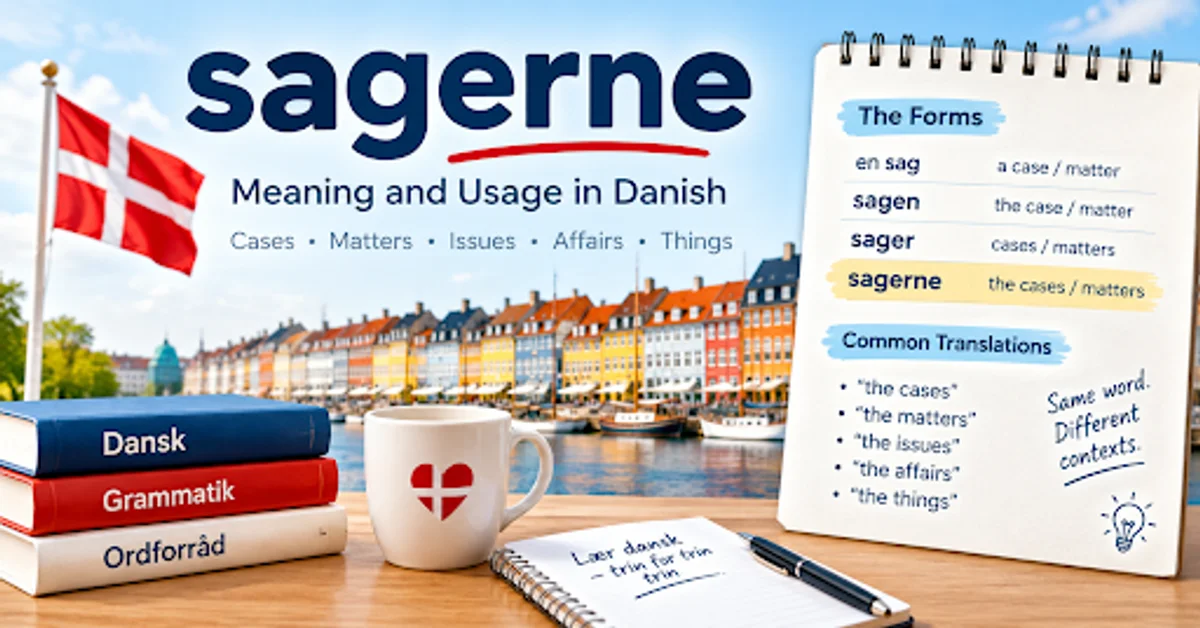
Sagerne is a Danish word. It is the definite plural form of “sag,” a noun that can mean “case,” “matter,” or “issue.” Although its basic grammatical meaning is straightforward, choosing the right English translation requires attention to the surrounding sentence.
At its core, sagerne is the definite plural form of the Danish noun sag. Depending on context, it can mean “the cases,” “the matters,” “the issues,” “the affairs,” or, in some situations, a natural English equivalent such as “the things.”
This guide explains the sagerne meaning, its grammar, pronunciation, translation, expressions, and practical use. It is designed for Danish language learners who want to understand not just the dictionary definition, but how the word actually works.
Related: BoyEnd: A Complete Guide to Boys’ Fashion
What Does Sagerne Mean?
The Basic Meaning of Sagerne
So, what does sagerne mean? The most direct answer is “the cases” or “the matters.” However, that translation is only a starting point. The Danish word sagerne can describe different kinds of known or specific matters.
The word comes from sag, a common-gender Danish noun. In a court setting, sag can refer to a case. In a workplace, it can describe a matter or issue that requires attention. In everyday Danish, it can have an even broader meaning.
Therefore, the sagerne definition should always be understood alongside the sentence where it appears. This is particularly important for Danish-English translation because English does not always express definiteness and context in the same way.
Why Context Changes the Translation
Context is essential when translating sagerne in English. A legal report may naturally use “the cases,” while a manager discussing unfinished work might use “the matters” or “the issues.”
For example, Dommeren gennemgik sagerne can naturally be translated as “The judge reviewed the cases.” By contrast, Vi må kigge på sagerne could mean “We need to look at the matters” or “We need to review the cases,” depending on the setting.
This is why a strong translation focuses on meaning rather than mechanically replacing each Danish word with an English equivalent.
The Grammar Behind Sagerne
From Sag to Sagerne
Understanding sagerne grammar becomes much easier when the four basic forms are placed together:
- en sag — a case or matter
- sagen — the case or matter
- sager — cases or matters
- sagerne — the cases or matters
This pattern demonstrates an important feature of Danish noun forms. The noun changes according to grammatical number and definiteness.
The Danish word sag is the base form. Adding the plural ending produces sager, while the definite plural form becomes sagerne. Learning these forms together is more effective than memorizing sagerne in isolation.
Understanding the Definite Plural Form
Danish has a distinctive way of marking definite nouns. English normally places “the” before a noun, while Danish often expresses definiteness through an ending attached to the noun.
In simple terms, sager means “cases” or “matters,” while sagerne means “the cases” or “the matters.” The ending -ne tells the reader that the speaker is referring to a particular or known group.
This makes sagerne a useful example of Danish definite plural and Danish definite nouns. It also helps language learners understand how Danish noun inflection differs from English.
Sagerne in English Translation
“The Cases” and “The Matters”
The most common sagerne translation choices include “the cases,” “the matters,” and “the issues.” The best choice depends on the subject.
In legal Danish, “the cases” is often the clearest option. In business communication, “the matters” may sound more natural. When discussing problems, “the issues” can communicate the intended meaning more effectively.
Other possible translations include “the affairs,” “the files,” or “the things.” These alternatives show why sagerne English meaning cannot be reduced to one permanent English word.
Choosing the Most Natural Translation
Good Danish-English translation is not always literal translation. The goal is to preserve the meaning and tone of the original sentence.
For instance, Hun har styr på sagerne could literally suggest that she has control of “the matters.” Natural English would be closer to “She has everything under control.” The literal version is understandable, but the natural version communicates the expression more effectively.
This approach is valuable for both professional translators and Danish language learners. Instead of asking only “What does this word mean?”, ask “What does this word mean here?”
Sagerne in Legal and Official Language
Sagerne in Court and Legal Contexts
Legal language provides one of the clearest examples of sagerne. In this setting, the word commonly refers to cases, proceedings, or legal matters being considered.
A sentence such as Dommeren gennemgik sagerne can be translated as “The judge reviewed the cases.” Here, “cases” is much more precise than “things” because the surrounding subject is clearly connected to Danish courts.
The word may also appear in reports concerning trials, investigations, appeals, administrative decisions, or other official proceedings. Understanding the context allows readers to identify the intended meaning quickly.
Sagerne in Public and Government Matters
The term can also appear in government offices and public administration. A public employee might discuss applications, complaints, records, or matters requiring official action.
In such circumstances, “the cases,” “the matters,” or “the files” may each be appropriate depending on what sagerne actually refers to. This flexibility is common in formal Danish and shows why context-based translation is so important.
Readers encountering Danish news should therefore avoid assuming that every occurrence of sagerne concerns a courtroom. The word can describe a much wider group of official matters.
Sagerne in Work and Business
Using Sagerne for Tasks, Files, and Issues
In Danish business communication, sagerne can describe matters that employees need to review, complete, organize, or resolve. A lawyer might use it for client cases, while an administrator might use it for applications or files.
The word can therefore overlap with English terms such as “matters,” “cases,” “issues,” “files,” and “tasks.” The professional setting determines which translation sounds most natural.
This broad usage makes sagerne especially useful for people learning Danish workplace language. It teaches that vocabulary should be understood as part of a situation rather than as isolated dictionary entries.
Examples from Workplace Communication
Consider the sentence Vi må kigge på sagerne. Depending on the office environment, this could mean “We need to look at the matters,” “We need to review the cases,” or “We need to go through the files.”
Another example might involve a manager asking colleagues to organize unfinished work. In that context, sagerne could refer to several outstanding matters rather than formal legal cases.
These examples demonstrate how Danish workplace language can use familiar nouns in flexible ways. Recognizing the broader meaning makes professional conversations easier to understand.
Sagerne in Everyday Danish
Personal and Practical Matters
Sagerne in Danish is not limited to formal writing. The word can appear in everyday conversations about personal matters, practical problems, unfinished work, belongings, or situations that require attention.
For example, someone discussing household responsibilities might use the word to refer broadly to matters that need to be sorted out. The exact English translation could therefore be “things,” “issues,” or “matters.”
This flexible usage is one reason why common Danish words can sometimes be challenging for beginners. A dictionary may provide several meanings, but real understanding comes from seeing the word used in complete sentences.
How Native Speakers Use the Word
In Danish everyday speech, speakers rely heavily on context. They may not consciously distinguish between every possible English translation because the intended meaning is obvious from the situation.
For language learners, however, the situation may not be immediately clear. Paying attention to the topic, surrounding nouns, verbs, and tone can reveal what sagerne means.
The same word may therefore sound formal in one sentence and completely ordinary in another. This is a normal feature of vocabulary across languages, including the other Scandinavian languages.
Common Danish Expressions With Sagerne
Orden i Sagerne
One particularly useful expression is orden i sagerne. Its meaning is not simply “order in the cases.” Instead, it generally conveys the idea of having things organized or under control.
The expression can relate to paperwork, finances, schedules, work, household duties, or other practical responsibilities. A person who has orden i sagerne has their affairs organized.
This is an excellent example of why Danish phrases should sometimes be learned as complete expressions. Translating every word separately can produce an unnatural English sentence.
Styr på Sagerne
Another useful expression is styr på sagerne. The phrase relates to having control over matters or knowing what needs to be handled.
Its natural English equivalent can change with context. “Have everything under control,” “know what is going on,” or “have things organized” may communicate the intended meaning better than a literal translation.
These expressions demonstrate the richness of Danish vocabulary. The noun sager does not always point to legal cases; it can represent a wider collection of matters or things.
Common Grammar and Translation Mistakes
One frequent mistake is translating sagerne as “the cases” every time. Although that can be correct, it may be inappropriate in workplace or everyday contexts.
Another mistake is confusing sager with sagerne. The first is indefinite plural, while the second is definite plural. The small ending carries grammatical information.
Learners should also avoid translating fixed expressions word for word. A phrase such as orden i sagerne needs to be understood as a complete expression rather than as a collection of independent English equivalents.
Sagerne Pronunciation and Spelling
How to Pronounce Sagerne
The sagerne pronunciation may initially seem difficult to English speakers because Danish pronunciation does not always follow English spelling expectations.
Rather than pronouncing each written letter with equal emphasis, learners should listen to native Danish speech and pay attention to rhythm, vowel quality, and the softer sounds common in Danish.
Audio examples from reliable Danish-language resources can help learners develop a more natural pronunciation. Listening repeatedly and imitating the rhythm is generally more useful than trying to pronounce the spelling according to English rules.
Tips for Remembering the Spelling
The first form represents one case or matter. The second represents several cases or matters. The third identifies a known group.
This approach also reinforces Danish noun inflection, grammatical number, and the Danish definite article. Instead of memorizing one complicated-looking word, learners can understand how the form is constructed.
Why Sagerne Matters for Danish Learners
A Useful Window Into Danish Vocabulary
Learning sagerne provides more than one new vocabulary item. It introduces learners to Danish noun forms, definite plural, context-based translation, and common expressions.
It also demonstrates an important feature of North Germanic languages within the wider Germanic languages family: grammatical systems may express meaning differently from English. Understanding these differences builds stronger reading and translation skills.
Using Reliable Language Resources
When checking the meaning or usage of a Danish word, learners can consult resources such as Den Danske Ordbog, Dansk Sprognævn, Wiktionary, Cambridge Dictionary, and Collins Dictionary. Translation tools such as Google Translate can also provide a starting point, but context should always be checked before accepting an automated translation.
For serious Danish translation, dictionary definitions, authentic examples, and the surrounding sentence are more valuable than relying on one isolated English equivalent.
Related: TozyMagazine.com: Your Guide to the Online Magazine
Frequently Asked Questions
What does sagerne mean in English?
Sagerne commonly means “the cases” or “the matters,” but it can also mean “the issues,” “the affairs,” or another natural equivalent depending on context.
Is sagerne a Danish word?
Yes. Sagerne is a Danish noun form derived from sag, meaning a case, matter, or issue.
What is the difference between sager and sagerne?
Sager is the indefinite plural, meaning “cases” or “matters.” Sagerne is the definite plural, meaning “the cases” or “the matters.”
What does sag mean in English?
The Danish noun sag commonly means “case,” “matter,” or “issue.” Its exact translation depends on the context.
What does orden i sagerne mean?
It generally means having things organized, having one’s affairs in order, or having everything under control.
Can sagerne mean “things”?
Yes, in some everyday contexts a natural English translation may be “things,” although the exact choice depends on the sentence.
Summary
Sagerne is a small but remarkably useful Danish word. Its foundation is simple: sag means a case or matter, sager is the plural, and sagerne is the definite plural. The challenge comes from its wide range of practical meanings.
In legal contexts, “the cases” may be the clearest translation. In business, “the matters” or “the issues” may work better. In everyday Danish, the word can refer more broadly to things or practical affairs.
For Danish language learners, mastering sagerne is therefore an opportunity to understand much more than one word. It demonstrates how Danish grammar, vocabulary, context, and expressions work together to create precise meaning. Once learners recognize the difference between sag, sagen, sager, and sagerne, this versatile word becomes much easier to read, translate, and use confidently.



[…] Related: Sagerne: Meaning and Usage in Danish […]