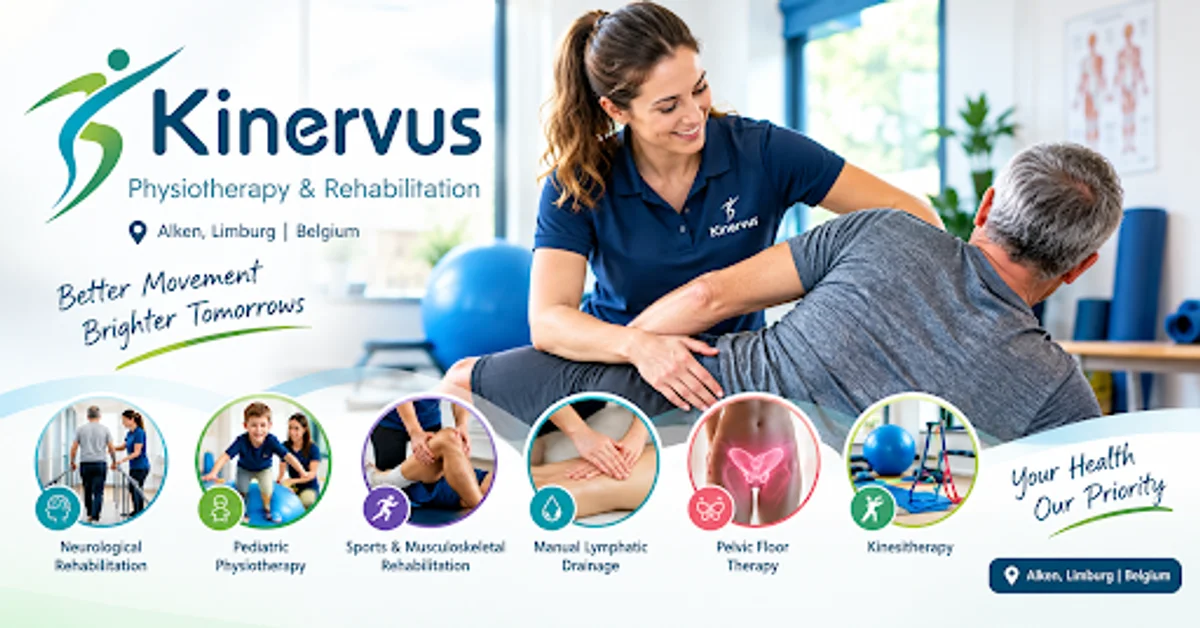
Kinervus is a physiotherapy and rehabilitation practice associated with Alken, Limburg, Belgium. Public Belgian listings identify it as a kinesitherapy practice and connect the name with Stefanie Ver Eecken. Its documented areas include neurological and pediatric rehabilitation, manual lymphatic drainage, kinesitherapy, and pelvic floor therapy.
The practice is best understood as a place for professional physical rehabilitation rather than as a medical diagnosis, medicine, or wellness product. Kinervus physiotherapy focuses on movement, physical function, recovery, and practical rehabilitation needs. Depending on the patient, treatment may involve therapeutic exercises, functional movement, specialized physiotherapy techniques, and ongoing assessment.
An important idea behind modern rehabilitation is that treatment should reflect the individual rather than simply the diagnosis. Two people with the same neurological condition, injury, or movement problem can have very different abilities, goals, and daily challenges. For this reason, Kinervus personalized rehabilitation can be understood through assessment, goal setting, appropriate treatment, and progress evaluation.
This approach also connects therapy with everyday life. A useful rehabilitation program may focus on walking, balance, coordination, strength, mobility, motor control, or independence depending on what the person needs. Evidence-based stroke rehabilitation guidance, for example, emphasizes meaningful, repetitive, progressively adapted, task-specific, and goal-oriented training.
Related: Neworldsmagazine.com: A Complete Website Guide
Where Is Kinervus Located?
Kinervus in Alken, Belgium
People searching for Kinervus Belgium, Kinervus Alken, or Kinervus Alken Belgium are generally looking for the physiotherapy practice located in Alken, within the Belgian province of Limburg. Public local listings associate Kinervus with Steenweg 121 Z/C, 3570 Alken, while other business information also lists Hoogsimsestraat 27 in Alken in connection with Stefanie Ver Eecken or the business.
This local presence makes Kinervus relevant to people researching physiotherapy in Alken or rehabilitation in Alken. Anyone planning a visit should verify the current appointment location directly with the practice because healthcare practices can change schedules, therapists, or consultation locations.
Accessibility and Patient Facilities
Accessibility is particularly important in rehabilitation because patients may have temporary or long-term difficulties with walking, balance, strength, or mobility. A suitable rehabilitation environment should make it easier for patients to reach treatment, move safely through the facility, and participate comfortably in therapy.
For current accessibility arrangements, patients should confirm details with the Kinervus team before their appointment. This is especially useful for people who use mobility aids or require specific accommodations. Practical preparation can make the first visit smoother and allow more attention to be placed on the rehabilitation assessment itself.
What Services Does Kinervus Offer?
Neurological Rehabilitation
Kinervus neurological rehabilitation is one of the most important areas associated with the practice. Neurological physiotherapy supports people whose movement or physical function has been affected by conditions involving the nervous system. Depending on the individual’s situation, rehabilitation may address balance, coordination, mobility, motor control, strength, endurance, or functional independence.
Conditions such as Stroke, Parkinson’s Disease, Multiple Sclerosis, ALS, Spinal Cord Injury, and Traumatic Brain Injury can produce very different rehabilitation challenges. Treatment therefore needs to be individualized. Rehabilitation may involve repeated practice of meaningful movements and everyday tasks, with difficulty adjusted as abilities change.
Pediatric Physiotherapy
Kinervus pediatric rehabilitation focuses on children who require additional support with movement, posture, coordination, or motor development. Pediatric physiotherapy is different from adult physical therapy because children are still developing physical skills and may respond best to activities suited to their age and interests.
Treatment can support areas such as balance, motor skills, coordination, movement control, and functional participation. When appropriate, family involvement can also help connect professional therapy with suitable activities at home. The goal is not simply to perform exercises but to help children develop useful physical abilities in an encouraging environment.
Musculoskeletal and Sports Rehabilitation
Musculoskeletal physiotherapy deals with problems involving muscles, joints, movement, and physical function. Kinervus sports rehabilitation can be relevant to active people recovering from an injury or working toward a safe return to physical activity. Treatment may focus on strength, mobility, stability, coordination, flexibility, and movement quality.
Sports injury rehabilitation is usually progressive. Physical demands can be increased as function improves rather than immediately returning to the highest level of activity. A therapist can help determine appropriate exercises and progression based on the injury, current abilities, and activity requirements.
How Does Kinervus Rehabilitation Work?
Initial Assessment and Goal Setting
A rehabilitation program normally begins by understanding the person’s current situation. A rehabilitation assessment may consider movement, strength, balance, mobility, coordination, pain, physical limitations, and difficulties with everyday activities. The therapist can then identify practical areas that need attention.
Goal setting gives this assessment a clear direction. One patient may want to improve walking, another may want to regain hand function, while an athlete may want to return gradually to a particular activity. Goal-oriented rehabilitation helps connect therapy with outcomes that matter to the individual.
Personalized Treatment Plans
After assessment, the therapist can develop an individualized treatment plan. Kinervus personalized rehabilitation may combine therapeutic exercises, functional movement, manual techniques, neurological exercises, or other appropriate physiotherapy techniques depending on the patient’s needs.
Personalization is important because rehabilitation is rarely identical from one person to another. Age, diagnosis, physical ability, previous treatment, daily responsibilities, and personal objectives can all affect treatment planning. A flexible program can therefore be more useful than a fixed routine.
Progress Monitoring and Treatment Adjustments
Rehabilitation is not necessarily a straight line. Physical abilities can improve, new challenges can appear, and some exercises may become easier over time. Regular progress evaluation allows therapists to determine whether treatment needs to be maintained, progressed, reduced, or changed.
This continuing process helps keep rehabilitation focused on current needs. Instead of assuming that the original plan will remain appropriate throughout treatment, therapists can use feedback and observed progress to make sensible adjustments.
Neurological Rehabilitation at Kinervus
Conditions Supported Through Neurological Care
Neurological rehabilitation can help people manage physical difficulties associated with a wide range of neurological conditions. Stroke rehabilitation, for example, may address walking, balance, arm and hand function, coordination, transfers, and other activities of daily living. Rehabilitation for Parkinson’s Disease or Multiple Sclerosis may involve different priorities depending on the person’s symptoms and functional abilities.
Other conditions, including ALS, spinal cord injuries, and traumatic brain injuries, can also create complex rehabilitation needs. The purpose of neurological physiotherapy is not to apply one universal exercise program. Instead, treatment is adapted to the person’s abilities, limitations, medical situation, and functional objectives.
Movement, Balance, and Functional Training
Movement rehabilitation can include balance training, mobility exercises, coordination activities, strength work, and repeated practice of meaningful functional tasks. Neuroplasticity, the nervous system’s capacity to adapt in response to experience and activity, is an important scientific concept in neurological rehabilitation, although the potential for recovery varies considerably by condition and individual.
Evidence-based stroke guidance supports repetitive, task-specific, progressively adapted, and goal-oriented training for appropriate patients. This illustrates why functional practice can be valuable: rehabilitation is often about improving what a person can actually do, not simply changing an isolated physical measurement.
Pediatric Rehabilitation at Kinervus
Supporting Motor Development
Children develop movement skills at different rates, and some children require additional therapeutic support. Pediatric rehabilitation can address challenges involving motor development, coordination, posture, balance, strength, and functional movement.
A pediatric physiotherapy session may therefore look different from an adult rehabilitation session. Activities can be adapted to the child’s age and abilities so that movement practice remains engaging and purposeful. The broader aim is to support useful physical skills and participation in everyday activities.
Family Involvement in Pediatric Therapy
Parents and caregivers can play an important role in pediatric rehabilitation. Understanding the child’s goals can help families support appropriate activities outside the clinic without turning everyday life into a constant therapy session.
Good communication between therapists and families also helps ensure that treatment remains realistic. A child’s interests, routines, school activities, and home environment may all influence how rehabilitation goals are approached.
Manual Lymphatic Drainage and the Vodder Method
How Manual Lymphatic Drainage Works
Kinervus lymphatic drainage includes Manual Lymphatic Drainage, a specialized hands-on technique that is distinct from ordinary massage. The Vodder Method is a recognized approach to manual lymph drainage that uses specific, gentle movements intended to support lymphatic fluid movement.
Manual lymphatic drainage may be incorporated into care for selected lymphatic problems, including lymphedema, when clinically appropriate. Because swelling can have different causes, professional assessment is important before choosing a treatment approach.
When Lymphatic Rehabilitation May Be Used
Lymphatic rehabilitation can be relevant when a person has problems involving fluid accumulation or lymphatic function. Treatment should be selected according to the cause and characteristics of the swelling rather than assuming that every type of swelling requires the same therapy.
For this reason, Kinervus manual lymph drainage should be viewed as one specialized component of rehabilitation rather than a universal solution. Patients should discuss their condition with a qualified healthcare professional to determine whether this technique is appropriate.
Sports and Musculoskeletal Physiotherapy
Injury Recovery and Functional Rehabilitation
Musculoskeletal rehabilitation focuses on restoring useful physical function following appropriate treatment for injuries or movement problems. Kinervus sports rehabilitation can support active people who need to rebuild strength, mobility, coordination, stability, or confidence following an injury.
A good rehabilitation program looks beyond the immediate symptom. For example, someone returning to sport may need to regain the ability to perform specific movements repeatedly and safely. The therapist can gradually introduce appropriate challenges as physical capacity develops.
Gradual Return to Physical Activity
Returning to sport is usually a process rather than a single event. Rushing back to demanding activity before sufficient recovery may place unnecessary stress on the injured area. A progressive rehabilitation plan can instead increase physical demands in stages.
The exact progression depends on the injury and the individual. Factors such as strength, mobility, pain, balance, coordination, endurance, and sport-specific demands may all influence the process. Professional assessment helps determine what progression is appropriate.
What Techniques Are Used at Kinervus?
Therapeutic Exercise and Functional Movement
Therapeutic exercise is a central part of many physiotherapy programs. Exercises may target strength, mobility, endurance, balance, coordination, stability, or movement control. Functional rehabilitation connects these physical abilities with practical activities such as walking, transferring, reaching, or other everyday movements.
For neurological patients, repeated practice can be particularly important. Stroke rehabilitation recommendations emphasize active, meaningful, repetitive, task-specific practice that can be progressively adapted to the person’s abilities.
Dry Needling, Kinesiotaping, and Manual Techniques
Some physiotherapy programs may incorporate techniques such as dry needling, kinesiotaping, or manual therapy when considered appropriate. These methods should not be viewed as replacements for a complete rehabilitation program. Their usefulness depends on the patient’s condition, treatment goals, and professional assessment.
The broader principle is that Kinervus treatment should be selected according to individual needs. Exercises, manual techniques, movement training, and specialized approaches can have different roles. A qualified therapist determines which combination is appropriate rather than applying every available technique to every patient.
What Can Patients Expect From Kinervus?
Preparing for Your First Appointment
Before a Kinervus appointment, it can be useful to prepare relevant medical information, previous treatment details, prescriptions or referral documents when required, and information about current difficulties. Patients should also think about the activities they want to improve.
Clear communication can make the initial assessment more productive. Explaining when a problem began, which activities are difficult, what treatment has already been tried, and what goals matter most gives the therapist useful context for treatment planning.
The Importance of Patient Participation and Consistency
Rehabilitation works as a partnership between the patient and therapist. Professional guidance is important, but active participation, communication, and appropriate practice can also contribute to the rehabilitation process. Patients should follow their therapist’s instructions and report changes, difficulties, or concerns.
Consistency is particularly valuable when rehabilitation involves repeated movement practice. Evidence-based rehabilitation guidance supports structured, progressively adapted, goal-oriented practice for appropriate neurological patients. However, recovery differs from person to person, so patients should avoid comparing their progress with someone else’s.
Why Kinervus Is Relevant to Modern Rehabilitation
The strength of a rehabilitation practice is not simply the number of techniques it offers. What matters is whether treatment is appropriate for the person’s condition, practical goals, abilities, and stage of recovery. This is where individualized physiotherapy can provide a structured path forward.
Kinervus brings together several areas of physical therapy, including neurological rehabilitation, pediatric care, kinesitherapy, lymphatic treatment, and pelvic floor therapy. Public Belgian listings specifically associate the practice with these services and with Stefanie Ver Eecken in Alken.
For people researching physiotherapy Belgium or rehabilitation Belgium, Kinervus therefore represents a local practice worth understanding through its actual services rather than vague online definitions. Its focus on rehabilitation allows patients to explore care that is connected to movement, physical function, and individual goals.
Related: Trideltathon: The Ultimate Knoxville Race Guide
Frequently Asked Questions
What is Kinervus?
Kinervus is a physiotherapy and rehabilitation practice in Alken, Belgium, offering services such as neurological rehabilitation, pediatric physiotherapy, musculoskeletal care, and manual lymphatic drainage.
Where is Kinervus located?
Kinervus is located in Alken, in the Limburg region of Belgium. Patients should confirm the current address and appointment details directly with the practice before visiting.
What services does Kinervus provide?
Kinervus provides several rehabilitation services, including neurological physiotherapy, pediatric rehabilitation, sports rehabilitation, musculoskeletal physiotherapy, kinesitherapy, pelvic floor therapy, and manual lymphatic drainage.
Does Kinervus offer neurological rehabilitation?
Yes. Kinervus provides neurological rehabilitation for people experiencing movement and functional challenges associated with conditions such as stroke, Parkinson’s disease, multiple sclerosis, spinal cord injuries, and traumatic brain injuries.
Does Kinervus provide pediatric physiotherapy?
Yes. Kinervus pediatric physiotherapy supports children who may need help with motor development, coordination, posture, balance, or other movement-related challenges.
Summary
Kinervus is a physiotherapy and rehabilitation practice in Alken, Limburg, Belgium, associated with physiotherapist Stefanie Ver Eecken. Public Belgian directories identify its services around kinesitherapy, neurological and pediatric rehabilitation, manual lymphatic drainage, and pelvic floor therapy.
The most useful way to understand Kinervus rehabilitation is through its patient-focused approach. Neurological physiotherapy can address movement and functional challenges, pediatric rehabilitation can support motor development, while musculoskeletal and sports rehabilitation can help people work toward physical recovery. Manual lymphatic drainage provides another specialized option for suitable patients.
Rehabilitation should always be individualized. A diagnosis alone does not determine the ideal treatment, and no technique can guarantee the same result for every person. A careful assessment, realistic goals, appropriate exercises, professional guidance, and ongoing evaluation provide a strong foundation for meaningful rehabilitation.